1
Bass
The deepest voice table — lowest formant centres, widest bandwidths. F1 sits around 250–600 Hz. The most recognisable "talking bass" vowel character, the default for dubstep and DnB.
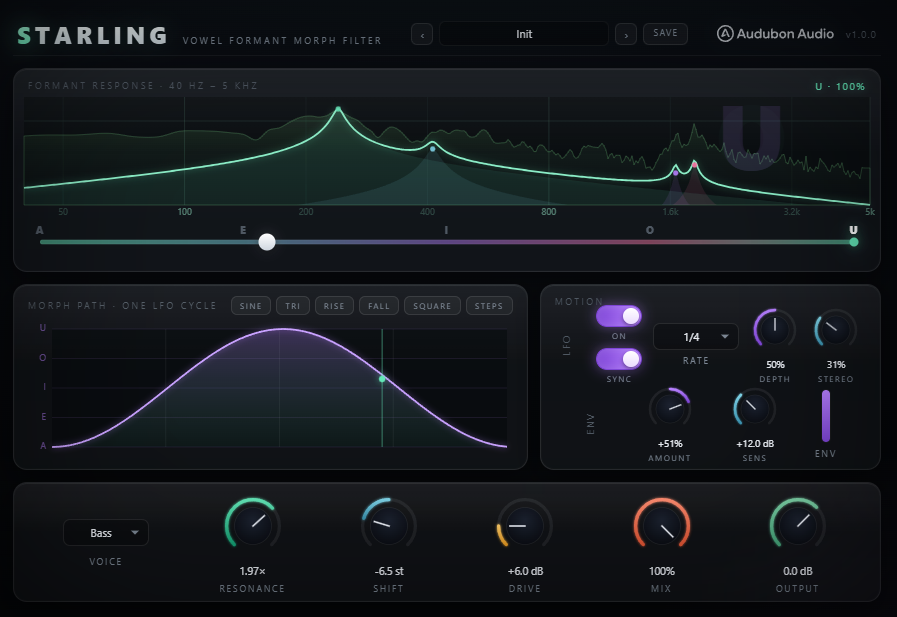
Four bandpass filters tuned to measured F1–F4 vocal formants, morphing through A E I O U in Bass, Tenor, Alto, or Soprano voice. Drive tanh to give the filters something to carve, then let the LFO, envelope follower, or Morph knob do the talking — synced to tempo, reactive to dynamics, or both at once.
A sub bass has almost no energy at the 600–3000 Hz range where vowels live. The tanh Drive stage manufactures the harmonic series the formant bank then carves into shape — the same technique a voice uses, built from the same acoustic measurements. The result is a talking, singing, morphing bass that doesn't just sound processed, it sounds alive.
Three independent morph sources add together: the Morph knob anchors the vowel position, the LFO scans a 64-point drawable path (tempo-synced or free), and a bipolar envelope follower pushes the vowel on every dynamics hit. Stack all three, or use just the one you need.
The hero panel shows the interpolated formant response curve in real time — every morph source moves the peaks live as you turn knobs. The A–E–I–O–U morph strip underneath tracks the LFO position as it plays. The drawn morph path is saved with your session and with every preset.
Each vowel is defined by four resonant bandpass filters (F1–F4), each with a centre frequency, relative level (dB), and bandwidth drawn from classic sung-voice acoustic measurements — the same tables every formant synthesizer since CSound has shipped.

F1–F4 formant data for Bass, Tenor, Alto, and Soprano voices across all five vowels — the acoustic foundation of every sung word, applied to your bass.
Frequencies interpolate geometrically (in cents, not Hz), so a constant morph sweep sounds like a constant number of semitones per second — the way a real mouth moves between vowels.
Input is soft-clipped by a tanh stage before the filters, generating the harmonic series the vowel bank then carves. The dry path stays untouched for the Mix blend.
The hero panel draws the interpolated filter response for the current vowel position in real time, with a spectrum analyser underneath — every morph source updates it instantly.
The Voice control selects which measured formant table is used. Each voice has a distinct resonant register — Bass sits lowest, Soprano highest. The Morph position glides through A E I O U within whichever voice you pick, and all three morph sources operate in that voice's register.
The deepest voice table — lowest formant centres, widest bandwidths. F1 sits around 250–600 Hz. The most recognisable "talking bass" vowel character, the default for dubstep and DnB.
Slightly higher formant positions than Bass — more midrange presence without the brightness of the female voices. Works well on tighter synth basses where Bass sounds too dark.
Higher formant centres and wider bandwidths than Tenor — a broader, more diffuse vowel shape. Suits full-mix use or when the vowel needs to blend rather than cut through.
The highest formant positions — sharp, nasal vowel articulation. F2 can exceed 2000 Hz, giving a bright, piercing talking quality that cuts through dense mixes.
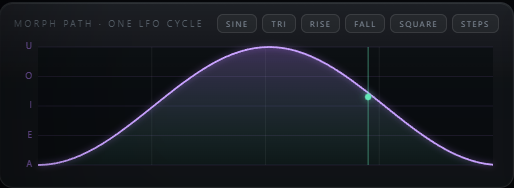
Freehand-draw any morph curve in the path editor. Six shape chips stamp common forms instantly: sine, triangle, ramp up, ramp down, square, and vowel steps (A→E→I→O→U as a staircase that snaps to each vowel position). The path is saved with the session and with user presets.
Full division table: 4/1, 2/1, 1/1, 1/2, 1/4, 1/8, 1/16, 1/32, 1/4., 1/8., 1/4T, 1/8T. Locks to the host's PPQ position when the transport rolls — restart-safe and deterministic. Freewheels at session tempo when the transport is stopped.
Depth (0–100%) crossfades the Morph knob toward the LFO path — at 0%, only the knob controls the vowel; at 100%, the path takes over entirely. Stereo offsets the right channel's path phase: 100% = half a cycle, so left says one vowel while right says another.
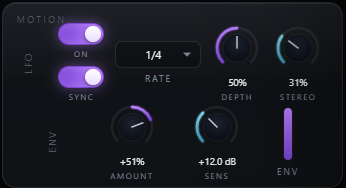
Positive amount pushes the vowel toward U on peaks; negative pushes toward A. Zero is fully inactive with no signal touching the morph position. Layer the envelope against the LFO for a vowel that's reactive to dynamics as well as time.
Stereo-linked peak detector with fixed 8 ms attack and 150 ms release — quick enough to catch a note attack, slow enough to ignore individual waveform cycles at bass rates. The result sounds like playing, not like buzzing.
Sensitivity pre-gains the signal going into the detector so a quiet synth patch can drive the envelope as fully as a loud one — a 36 dB range covering the full studio headroom spread.
Drive and Resonance shape the character of the formant peaks. Formant Shift moves all four centres together. Mix and Output finish the blend and level.
Vowel position along A→E→I→O→U. LFO and envelope amounts add to this anchor; at 0% and LFO off, the vowel is locked at A.
Pre-gain into the tanh stage, which generates harmonics for the filter bank to carve. Default 6 dB — raise it to hear the vowels deepen and saturate.
Multiplies each formant's natural Q. Below 1× = wider and wetter; above 1× = narrower and more nasal. The vowel character is preserved; only the sharpness changes.
Moves all four formant centres together in semitones, constant-Q (bandwidths scale with frequency). Simulate a smaller head or a larger resonant body without changing the vowel identity.
Dry/wet blend, default 100% (fully wet). Reduce for a subtler vowel colouration blended behind the original sound.
Final trim. The filter bank applies a fixed +6 dB wet makeup before the Mix blend; use Output to match loudness against bypass.
Each preset is a complete configuration — voice, morph path shape, LFO rate, Drive, Resonance, and envelope amount — saved together. User presets also store the drawn path, so a custom wobble shape you work out for a track is never lost.
Sine-sweep LFO, Bass voice, LFO on at 1/4 sync, 50% depth. The clean zero-point for building any talking-bass patch from scratch.
Square path snapping between E and O in eighth notes, 60% depth, Resonance 1.8× — the classic "yoi yoi" vowel stutter. Morph anchors at 60% so the snap stays between E and O.
Ramp-down path (U→A sweep) every beat. Heavy Drive at 14 dB, −3 st Formant Shift, 25% envelope amount — the "wow" that reacts to dynamics as well as time.
Slow full-sweep wah, half-bar (1/2) sync rate, Resonance 2.2× — exaggerated narrow peaks for a classic wah-wah character.
Vowel-staircase path on a Tenor voice, every bar: A→E→I→O→U in five even steps. Resonance 2.6×, Drive 12 dB — mechanical, precise, and in-your-face.
LFO off. Envelope amount 80%, Sensitivity 18 dB, Resonance 1.8× — every note hit pushes the vowel, purely reactive to playing dynamics. Classic auto-wah behaviour.
Slow free-running LFO at 0.28 Hz (unsynced), 35% depth, 45% Mix, Resonance 0.8×. A barely-there drifting vowel colour that sits behind the sound rather than leading it.
LFO off, Morph at 25% (between A and E), Resonance 1.6×. Static talk-box colouration with no movement. Automate the Morph knob manually for a dramatic vowel sweep at a drop.
