Zip
808 Zips
The classic dispersion sweep on a sub hit — a fast phase rotation that reads as a pitch-like zip without ever touching pitch or EQ.
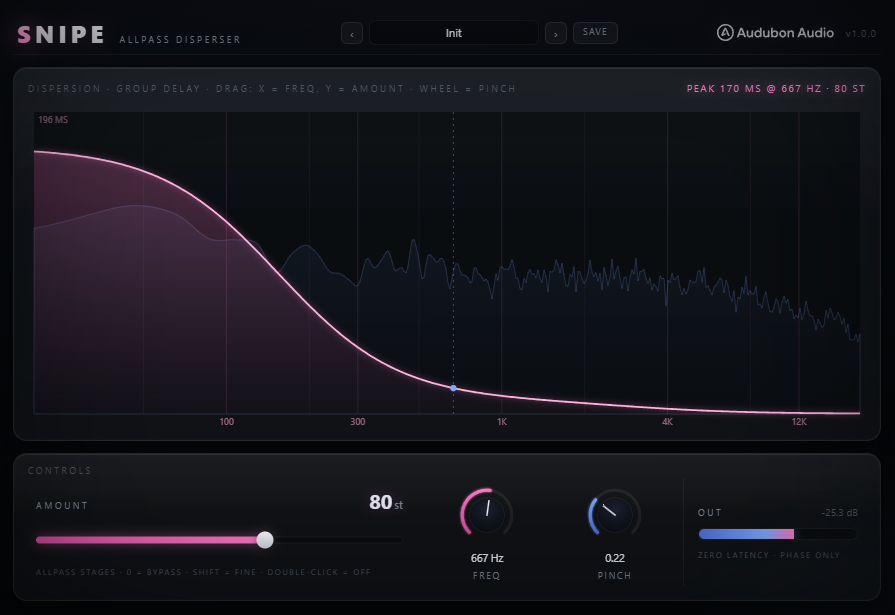
A kHs-Disperser-style chain of up to 128 allpass stages rotates phase around a centre frequency without touching your EQ curve at all. The frequency-dependent group delay this creates is the sound of 808 zips, rounded kicks, and laser risers.
An allpass disperser doesn't touch magnitude at all — every frequency passes through at the same level it came in at. What it does instead is delay different frequencies by different amounts, rotating phase around a centre frequency. That frequency-dependent group delay is what produces the classic dispersion "zip."
Deterministic and phase-coherent by design — the same input always produces the same output, with no randomization and nothing that could cause phase cancellation across a stereo or mono sum.
Snipe was forked from an earlier random-phase spectral blur approach that turned out too muddy for bass work. This is the real allpass architecture instead — a time-domain chain of identical 2nd-order stages, exactly what dedicated hardware and software dispersers use.
Each stage is a 2nd-order allpass filter tuned to the same centre frequency. Chaining more of them steepens the phase rotation around that centre — more stages, more dispersion.
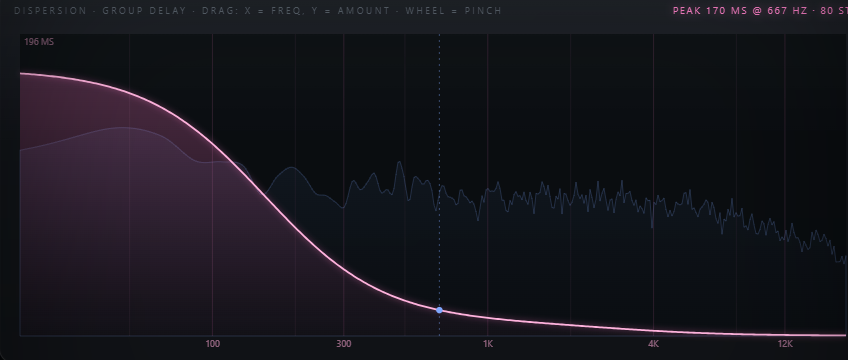
A kHs-Disperser-style chain of identical 2nd-order stages, all time-domain — the same architecture dedicated hardware/software dispersers use.
The live display shows the group-delay response over the spectrum — how much each frequency is time-shifted, not how loud it is.
Amount interpolates between stage counts smoothly rather than jumping in whole-stage steps, so automating it never clicks or zippers.
Amount at 0 stages is a true, bit-exact bypass — no dispersion filter is in the signal path at all.
The same phase-rotation trick, tuned to different centre frequencies and stage counts, covers a surprising range of bass-music staples.
The classic dispersion sweep on a sub hit — a fast phase rotation that reads as a pitch-like zip without ever touching pitch or EQ.
A gentler setting smooths a kick's transient shape by spreading its phase relationships, without changing its tonal balance.
Automate Freq across a build for a swept dispersion effect that reads as movement, layered on top of whatever else is rising.
Because magnitude is never touched, Snipe is safe to leave on a bass bus without worrying about tonal or mono-compatibility side effects.
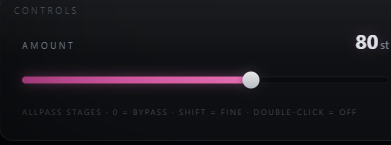
Sets how many allpass stages are chained. Low values give a subtle phase nudge; high values give a dramatic sweep-like dispersion.
At Amount 0, no filtering happens at all — the signal passes through completely untouched.
The hero display doubles as the control surface — drag vertically to set Amount directly on the group-delay curve you're watching.
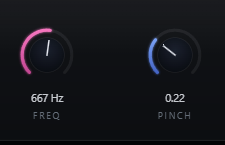
The frequency around which phase rotates. Drag horizontally on the hero display, or use the Freq control directly.
Narrows or widens each stage's effect around the centre frequency. Scroll the wheel on the hero display to adjust it without moving your cursor.
X-axis drag sets Freq, Y-axis drag sets Amount, mouse wheel sets Pinch, and a double-click turns the whole effect off — the entire plugin lives in one interactive view.
Snipe is deliberately minimal — everything it does comes from these three parameters, all reachable from the one interactive display.
How many allpass stages are chained — the main intensity control. 0 is true bypass.
The centre frequency phase rotates around.
Per-stage Q — how narrow or wide the effect sits around Freq.