A
Auto
Tracks pitch directly from the incoming audio signal — no MIDI needed. The default, and the simplest way to get in-tune growl.
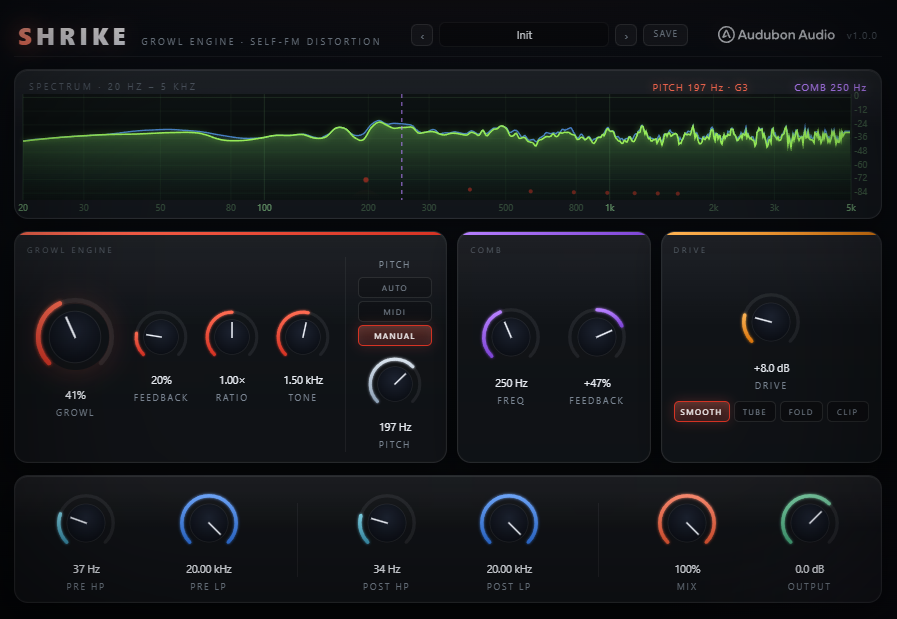
A key-tracked self-FM growl engine feeding a resonant comb filter and a four-shape waveshaper. Bass that snarls in tune with what you play, not just distortion bolted onto it.
Shrike feeds the input into a self-FM oscillator that follows the note you're playing — automatically from the signal, from incoming MIDI, or locked to a manual frequency — then runs the result through a resonant comb filter and a four-shape waveshaper. The growl moves with the music instead of sitting at a fixed pitch underneath it.
Three panels, left to right: the Growl Engine generates the self-FM character and tracks pitch; the Comb filter adds resonant, metallic edge; Drive and Shape push it into distortion. A live output spectrum and pitch readout sit across the top of the plugin.
Because the FM carrier tracks the input note, the growl's harmonic content shifts with your bassline instead of staying static — low notes get a low growl, high notes get a higher one, just like a real snarling amp would react differently across the neck.
Growl sets how hard the self-FM modulator drives the signal; Feedback pushes the FM into rawer, less predictable territory. Ratio and Tone shape the modulator's relationship to the tracked pitch.
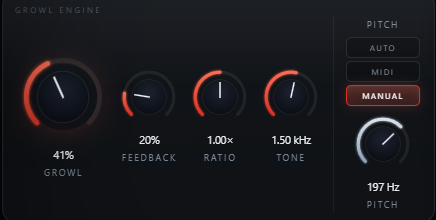
The main macro — how hard the self-FM modulator drives the input. Low for a subtle edge, high for a full snarl.
Feeds the modulator back into itself for a rawer, less predictable growl the harder you push it.
Sets the modulator frequency as a multiple of the tracked pitch — 0.25× to 4× — for inharmonic or harmonic growl character.
Colors the modulator itself, independent of the tracked pitch — brighter or darker growl texture.
Pitch Source decides what the self-FM modulator follows. Shape decides what the final waveshaper does to it.
Tracks pitch directly from the incoming audio signal — no MIDI needed. The default, and the simplest way to get in-tune growl.
Tracks the note-on pitch from incoming MIDI instead — useful when Shrike sits on a MIDI-driven bass or synth channel.
Locks the modulator to one fixed pitch (20–500 Hz) regardless of what's playing — a static growl character on purpose.
The gentlest of the four shapes — rounds peaks without hard edges.
Warm, asymmetric saturation reminiscent of overdriven valve gain stages.
Fold wraps peaks back on themselves for a harsher, more complex spectrum; Clip is the hardest and most aggressive of the four.
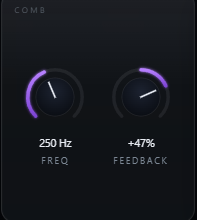
Sets the comb's base frequency — low for a growling resonant hum sitting under the note, higher for a thinner, more metallic character.
Positive feedback reinforces the comb's resonant peaks for a hollow, robotic edge; negative feedback thins it out differently. Zero is comb off.
The comb sits after the growl engine and before the waveshaper, so its resonance gets distorted along with everything else — not a separate effects tail.

Filter the signal before it reaches the growl engine — tighten up the low end going in, or tame harsh highs so the FM has less to chew on.
Filter after the distortion stage to control the harmonics the growl and shaper generate — keep sub weight clean, or roll off fizz on top.
Mix blends the processed growl against the dry input; Output trims the final level so A/B comparisons stay fair.
Drive pushes into the waveshaper; the four filters bracket it; Mix and Output bring it back into the mix.
Gain into the waveshaper. Combine with Shape to move from a light edge to a fully clipped growl.
Bracket what reaches the growl engine and comb filter.
Bracket what leaves the distortion stage before Mix.
Blends the processed signal against the dry input for parallel-style growl.
Final trim after everything else, for level-matched A/B comparisons.