1
Sine
The smoothest bend — symmetric sidebands and a rounded, vowel-like growl. The classic CZ starting point.
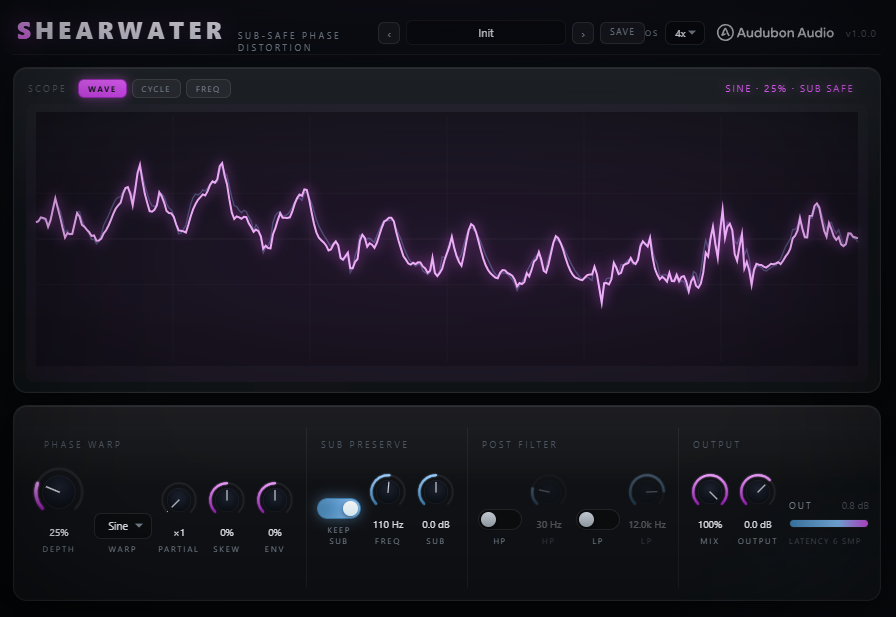
Casio-CZ-style phase distortion on live audio — the growl tracks your pitch because the warp rides the signal's own phase. Low latency, four warp shapes, oversampled so it stays clean when pushed, and the same mix-safe sub preserve so the low end stays put while the tops snarl.
Phase distortion warps a sound's timing, not its amplitude — so instead of clipping into fizz, it grows vowel-like formants and a growl that follows whatever note you play. Shearwater runs that engine on live audio and pairs it with the same mix-safe Sub Preserve, so the phase mangling never touches the mono low end a bass lives on.
Three views tell you exactly what's happening: WAVE shows the clean signal against the warped output, CYCLE draws one carrier cycle with the phase-bend curve underneath, and FREQ shows the spectrum with the protected sub region shaded and the post-filter responses overlaid.
Because the warp is keyed to the signal's own instantaneous phase, every new harmonic lands exactly on a multiple of what you're playing — pitch-tracked growl with no pitch tracker to mistrack, and no latency. Turn on only what the track needs.
The band is split into an analytic in-phase/quadrature pair, its instantaneous phase is warped by a bounded shape, and the signal is re-assembled as a single-sideband rotation. That's phase modulation on live audio — sidebands, not hard edges, so there's nothing to alias and nothing to oversample.
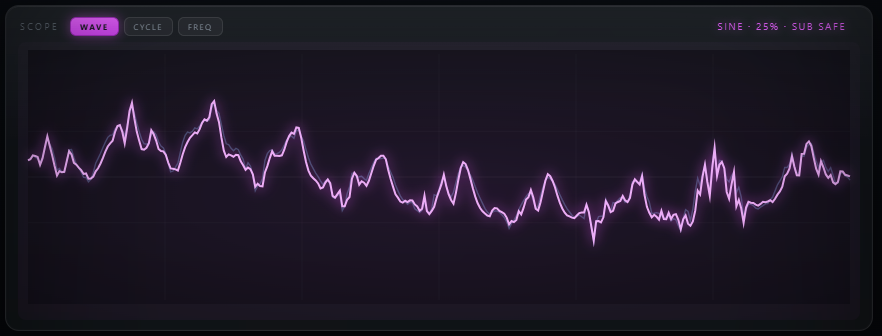
The warp rides the signal's own phase, so every harmonic it adds lands exactly on a multiple of your note — a tracking growl with no pitch tracker to chase or mistrack.
Pushed hard, the phase rotation throws sidebands past Nyquist. So it's oversampled — but only the rotation, never the splitter, so the low-end quadrature stays intact. Low latency, no pre-ringing.
The dry and preserved-sub paths run the same carrier allpass as the warped band, so all three recombine phase-coherently — no comb filtering as you blend.
The CYCLE view's JavaScript mirrors the actual DSP warp code exactly — the clean cosine against the phase-bent one is literally what's happening to the audio.
Each Warp is the periodic function that bends the phase — pick the character first, then set Depth for how far, Partial for how sharp, and Skew for the lean.
The smoothest bend — symmetric sidebands and a rounded, vowel-like growl. The classic CZ starting point.
A triangle bend — brighter and edgier, pushing more energy into the upper sidebands.
An asymmetric bend that leans the formant energy to one side — aggressive, sync-like snarl.
A squared-off bend — odd-heavy and hollow, the squarish talkbox character.
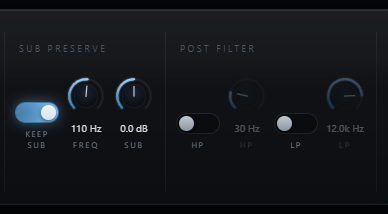
A Linkwitz-Riley crossover splits the input; only the high band is phase-warped. The untouched sub is added back afterward, pristine — phase mangling never reaches the mono low end.
The dry-for-mix signal is the allpass-reconstructed input, so the sub stays phase-coherent across the entire Mix range — no notching as you blend.
Set the crossover to sit right above your fundamental, and optionally boost the preserved sub back in with Sub Gain.
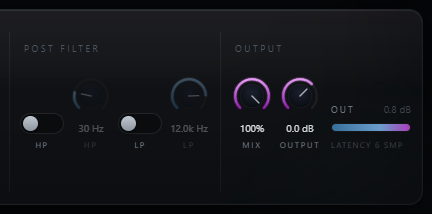
Gentle filters that sit before the sub is re-added — high-pass the growl's low mud out, or tame fizz up top, without ever touching the preserved sub.
Skew rotates the warp against the carrier cycle, throwing the sidebands asymmetric — the difference between a symmetric vowel and a nasal, one-sided snarl. A DC blocker keeps it clean, out of the path at Depth 0.
Env ties Depth to the input level. Push it positive and the warp opens as you dig in; pull it negative and the growl blooms on the decay for a reverse, swelling motion.
Depth, Partial and Skew set the bend; Env makes it move with the note; Mix and Output finish the blend.
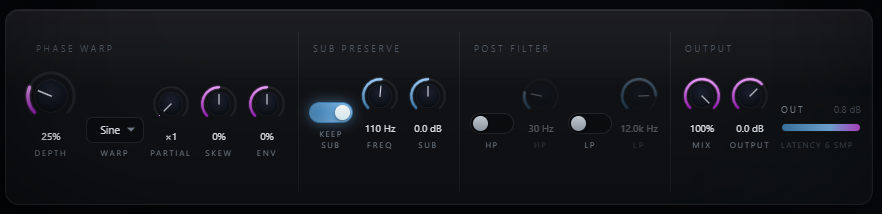
How far the phase is bent — from a subtle vowel at low settings to a full-cycle scream up top.
Which harmonic of the signal's phase drives the warp. Higher = sharper, sync-like formant peaks that still track the pitch.
Rotates the warp against the carrier for sideband asymmetry. Zero is symmetric, with the DC blocker's effect vanishing at Depth 0.
Envelope into Depth. Positive opens the warp with the note; negative blooms it on the decay.
Dry/wet blend. The dry is carrier-matched to the warped band, so it stays comb-free at every setting.
Final trim for level-matched comparisons against bypass.