Audubon · Plugins
ORI-001  ·  Released v1.1
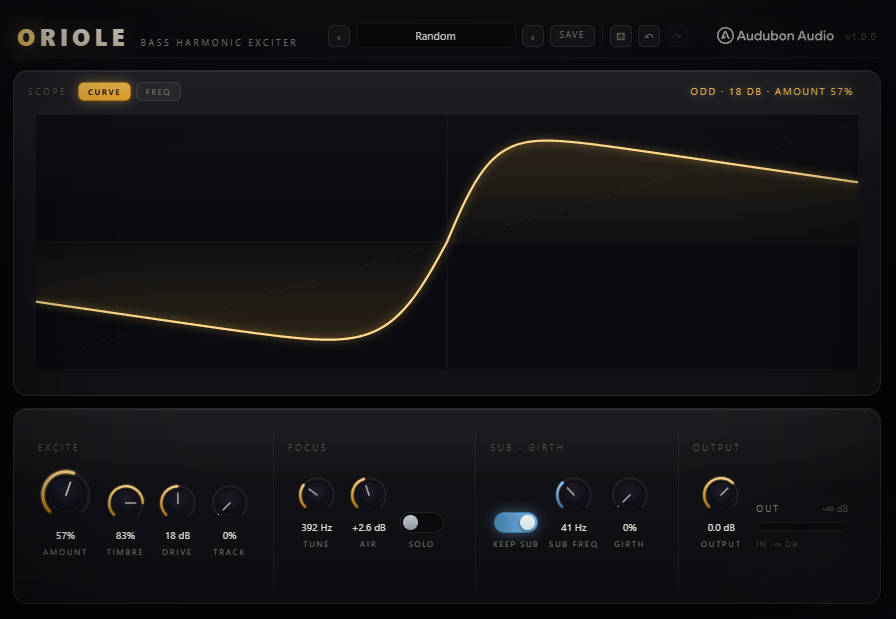
Oriole full plugin UI
NEW · VST3 PLUGIN EST. 2026 · AUDUBON AUDIO
Bass Harmonic Exciter

Oriole.
Harmonics that weren't there.

An exciter never reshapes your signal — it manufactures new harmonic content from a side-chained copy and adds it back in parallel, so the dry path stays pristine and the sub is never muddied. Zero latency, always.

Under development · v1.1.0
$29
Format
VST3 Fx · Win 64 · macOS Universal
Zones
3 Sub · Girth · Air
Latency
Zero ADAA, no oversampling
Signal Path
Parallel dry never touched
License
Royalty-free commercial OK
01 — Overview

Add, never reshape.

Oriole descends from CondorMultiband's Aphex-style Type-III exciter core, re-derived with closed-form antiderivative antialiasing so the whole plugin runs at zero latency. It generates new harmonic content from a side-chained copy of your signal and adds it back — the dry path underneath is never touched.

VST3 Harmonic Exciter Zero Latency Parallel Sub-Safe

A CURVE view shows the live harmonic-generator transfer function, and a FREQ view shows the output spectrum with the protected sub region shaded in ice, the Girth band and excited AIR region highlighted in gold, and the Air shelf overlaid.

With Amount and Girth both at zero, the harmonic sum collapses to zero and the pristine dry signal passes through untouched — a bit-exact bypass. Oriole always reports zero latency: no oversampling, no delay compensation needed.

Oriole full plugin UI
Plugin · full interface
02 — Three Zones

Sub stays clean. Everything above does the work.

Oriole splits the spectrum into three parallel zones, each doing a different job — and the sub is never in play.

Oriole output spectrum showing Sub, Girth and Air zones
Sub — Never Excited

Below Sub Freq, nothing is generated. With Keep Sub on, the harmonic sum is high-passed here too, so not one dB of manufactured energy lands under the sub.

Girth — Missing Fundamental

Between Sub Freq and roughly 3× that, even-harmonic weight sits above the source — the classic "missing fundamental" trick that lets phones and laptops hear bass they can't reproduce.

Air — The Main Exciter

Above Tune, the Aphex-style differential-pair generator does its work. Timbre sweeps it from even (warm) to odd (bright); Air adds a 10 kHz shelf of sheen.

Zero-Latency ADAA

The differential-pair generator has a closed-form antiderivative, so aliasing is suppressed at base rate — no oversampling, no phase smear in the low end.

03 — The Air Exciter

Warm or bright. Your call.

Am
Amount

The level of manufactured air harmonics added on top of the dry signal — the main exciter macro.
0 – 100%Default 30%
Dr
Drive

Pushes the side-chain harder into the generator for more and higher harmonics.

0 – 36 dBDefault 12 dB
Tm
Timbre

Generator asymmetry — 0 is even-harmonic and warm, 100 is odd-harmonic and bright.

0 – 100%Default 35%
Tn
Tune

The crossover above which the main exciter generates harmonics at all.

100 Hz – 9 kHzDefault 2 kHz
Ar
Air

A 10 kHz high-shelf of sheen laid on top of the generated harmonics.

0 – 6 dBDefault 1.5 dB
So
Solo

Monitor only the manufactured harmonics in isolation — great for dialling in the character before blending back.
On / OffDefault Off
04 — Girth

Bass you can hear on anything.

Oriole Girth control
A — Even Harmonics, Low
The Missing Fundamental Trick

Girth adds even-harmonic weight to the low band, above the source fundamental — the same psychoacoustic principle that lets small speakers imply bass they physically can't reproduce.

B — Shares the Sub Corner
Sub Freq Sets Both Edges

Sub Freq is both the sub-protect corner and the lower edge of the Girth band — one control, two jobs, always in sync.

C — Off by Default
0% Out of the Box

Girth defaults to 0% — an opt-in translation trick for material that needs to read on phone speakers and laptops, not a default coloration.

05 — Keep Sub

Not one dB, under the sub.

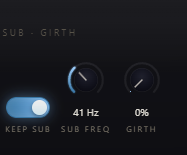
Oriole Keep Sub and Sub Freq controls
A — Keep Sub
High-Passes the Harmonic Sum

On by default. High-passes the entire generated harmonic sum at Sub Freq before it's added back — guaranteeing nothing manufactured lands under your sub.

B — Sub Freq
20 – 200 Hz

Set it to match your track's fundamental — the corner below which Oriole guarantees it never adds anything.

C — Dry Never Touched
The Real Guarantee

Keep Sub only filters the generated harmonics — the dry signal was never touched in the first place. This is belt-and-suspenders on top of the parallel architecture.

06 — Global Controls

Every knob, one screen.

Oriole full control layout
Amount
0 → 100 %

Level of the generated Air harmonics added on top of dry.

Drive
0 → 36 dB

Pushes the side-chain harder into the generator.

Girth
0 → 100 %

Even-harmonic bass translation weight, off by default.

Sub Freq
20 → 200 Hz

The sub-protect corner and the lower edge of the Girth band.

Output
−24 → 12 dB

Final trim for level-matched comparisons against bypass.

07 — Workflow

From insert to sheen, in six moves.

Oriole full plugin UI Oriole Sub, Girth and Keep Sub controls
01
Insert Oriole on a bass, drum bus, or full mix — anywhere that needs presence without losing sub weight.
02
Set Sub Freq to match your track's fundamental, and leave Keep Sub on to guarantee nothing lands underneath it.
03
Raise Amount and Drive to taste, and use Solo to hear only the generated harmonics while you dial in Timbre.
04
Set Tune to where you want the Air exciter to start working — lower for more of the spectrum excited, higher for a subtler top-end effect.
05
If the track needs to translate to small speakers, bring in Girth gradually — it's off by default for a reason.
06
Add a touch of Air for sheen on top, then trim Output to match bypass level for a fair A/B.
08 — Specifications

Everything, on one page.

Format
VST3
Category
Fx · Exciter / Enhancement
Platform
Windows 10 / 11 · macOS 10.13+ (Universal — Apple Silicon & Intel) · 64-bit
Version
1.1.0
Engine
Aphex-style differential-pair exciter, parallel side-chain, ADAA
Amount
0 – 100%, default 30%
Drive
0 – 36 dB, default 12 dB
Timbre
0 – 100% even↔odd, default 35%
Tune
100 Hz – 9 kHz crossover, default 2 kHz
Air
0 – 6 dB 10 kHz shelf, default 1.5 dB
Girth
0 – 100% even-harmonic bass translation, default 0%
Keep Sub / Sub Freq
On by default · 20 – 200 Hz, default 80 Hz
Solo
Off by default, monitors generated harmonics only
Output
−24 to +12 dB trim
Latency
0 samples, always — no oversampling, no delay compensation
State save
Full settings saved with DAW project
09 — Fine Print

Documentation.

DAW
Any VST3-compatible host — Ableton Live 11+, FL Studio 20+, Reaper, Cubase, Studio One, Bitwig, and others. VST3 only — Logic Pro and GarageBand load Audio Units, not VST3, so they are not supported.
Operating System
Windows 10 or 11 (64-bit) — the editor uses WebView2, which is built into Windows 11 and most current Windows 10 installs. macOS 10.13 High Sierra or later — one Universal build runs natively on both Apple Silicon and Intel Macs.
Format
VST3 effect. Insert on any bass, drum, or master channel where presence needs adding without touching the sub.
Latency
Always zero — Oriole never oversamples and never reports delay compensation.
Recommended Setup
Start with Sub Freq matched to your fundamental, Keep Sub on, Amount around 30%, Drive around 12 dB, and Timbre around 35% for a warm-leaning default.
Updates
Current release 1.1.0. Free updates for all future 1.x releases.
v1.1.0 — Update check, from the logo
The Audubon Audio wordmark in Oriole’s header is now a button. Click it and Oriole asks audubonaudio.com one question — which build is current — then shows that number beside the one you are running, with a link straight to the members area if there is something newer and a plain “you have the current version” if there is not. If it cannot reach us it says so rather than claiming you are up to date. This is the only moment Oriole touches the internet, it happens only on that click, and nothing about you goes with it — no serial, no licence, no machine id, not even your version or operating system. The comparison happens on your own machine.
v1.0.0 — Initial Release
First public release. Parallel Aphex-style Air exciter (Amount, Drive, Timbre, Tune, Air), Girth even-harmonic bass translation, Keep Sub protection with Sub Freq, Solo monitoring, and Output trim — zero latency throughout via closed-form ADAA.
Full User Guide
Step-by-step walkthrough of the three zones, the Air exciter, Girth, Keep Sub, and workflow recipes for bass that translates.
Open User Guide →
Personal & Commercial Use
Use Oriole in any project — music production, mixing, sound design, post-production, broadcast, and live performance. No royalties, no project restrictions.
Single User
One license per user. Install on the computers you personally own or operate.
Serial Activation
Your license includes a unique serial number tied to your email. Your serial and download are permanently accessible in your Members Area.
Free Updates
All 1.x updates are free. Your serial activates the current version and all future updates in the 1.x line.
No Redistribution
The plugin binaries may not be shared, resold, or redistributed. Each user must obtain their own license.
O
Oriole Bass Harmonic Exciter · VST3
$29