Th
Threshold
Each band's clip ceiling — the core control over how hard that band gets driven.
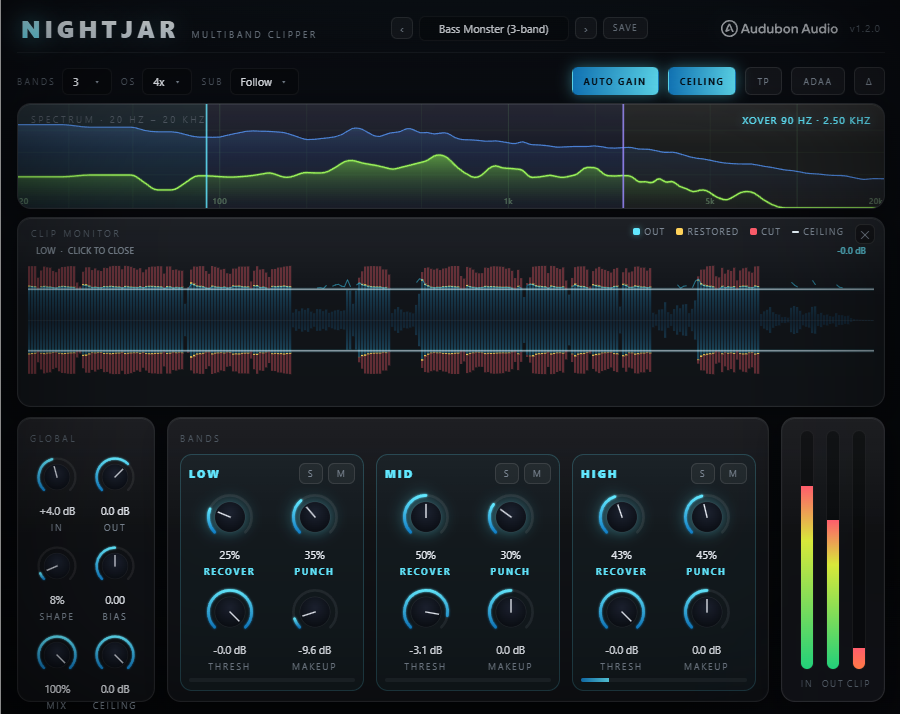
Clips for loudness like a top-tier oversampled clipper, but detects transients before the clip and uses them to put the slam and click back — per band. Not just another brickwall.
Clipping flattens peaks, which kills the slam of a kick and the click of a transient. Nightjar detects transients before the clip and uses them two ways — Punch lifts the ceiling on the leading edge before the wall clamps back, and Recover re-injects the peak in parallel after the clip. Both are gated so they only act on attacks; the body underneath stays clipped and loud.
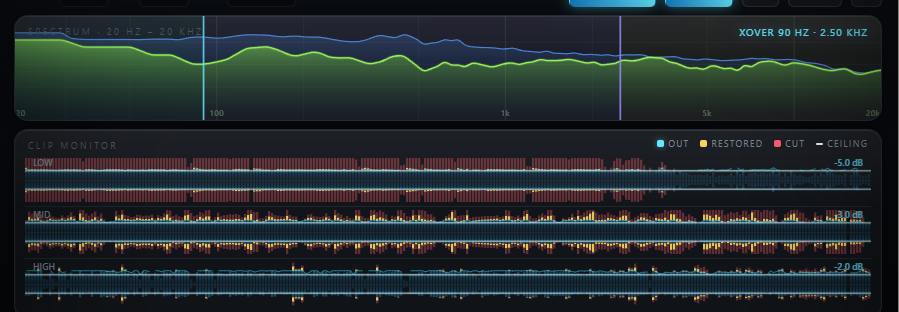
A live Clip Monitor shows exactly what's being cut and restored per band; a full-width spectrum analyser lets you drag the crossover handles directly to set the band splits.
Everything from the crossover through the per-band clipping runs inside the oversampled domain, so clip harmonics are band-limited and never alias. The dry path is latency- and phase-compensated, so intermediate Mix settings never comb around the crossover frequencies.
A level-independent dual-envelope detector — the gap between a fast and a slow envelope — drives both Punch and Recover, so sustained, already-loud material isn't touched by either.
A transient-aware ceiling lift inside the oversampled clip. The leading edge punches through, then the wall clamps back down — restoring impact and slam.
Parallel peak re-injection after the clip — the difference between input and clipped output is added back, scaled by the transient detector. Restores click and crest.
Crossover, clipping, Punch and Recover all run inside the oversampled domain — clip harmonics stay band-limited and alias-free.
In 2/3-band mode, the dry path runs through allpasses matching the crossover's phase rotation — no comb filtering at any Mix setting.
1 band bypasses the crossover entirely and is bit-transparent for its filtering; 2 and 3 bands split with X-Low and X-High, draggable straight from the spectrum display.
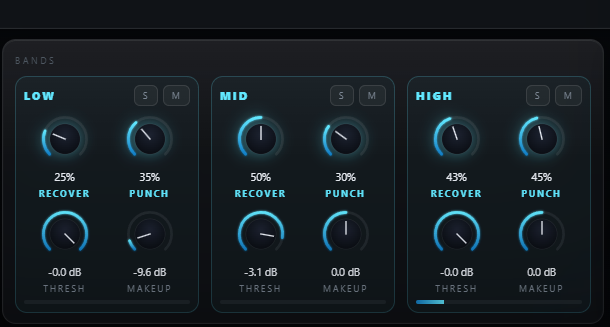
Each band's clip ceiling — the core control over how hard that band gets driven.
Independent per band, so a kick band can punch hard while a sub band stays glued.
Independent per band — dial in exactly how much click comes back on each part of the spectrum.
Per-band gain to balance levels between bands before they sum.
Audition any single band in isolation while you dial it in.
Drop any band entirely to hear what the rest are doing.
Morphs the clip character from a hard brickwall to a fully soft knee, applied globally across every active band.
Renormalised so the louder rail always lands exactly on the band's Threshold — bit-transparent at Bias 0, with a ~4 Hz DC guard removing the drift asymmetric clipping creates.
Drag the handles directly on the full-width spectrum analyser to set the band splits — they stay in sync with the X-Low/X-High knobs, with active bands shaded behind the curve.

A final output ceiling guarantees the peak after everything else. On by default, since it's the last line of defense against overs.
A 4× true-peak (ISP) mode is available for delivery specs that require it — off by default, since it trades away loudness that most bass-music workflows want to keep.
Monitors dry minus wet, scaled by Mix, so it always equals bypass minus output — you hear exactly what the clipper is removing or adding, nothing more.
Input and Output bracket the process; Mix, Oversample, and Auto-Gain round it out.
How hard the signal is pushed into the ceiling before it's clipped.
Parallel dry/wet blend for the clipping, phase-matched across bands.
Compensates the input drive so loudness stays roughly matched as you push Input harder. On by default — approximate, not a loudness meter match.
Final trim after the ceiling, for level-matched comparisons against bypass.
Linear-phase FIR oversampling for the whole clip path — higher settings keep the hardest clipping alias-free.