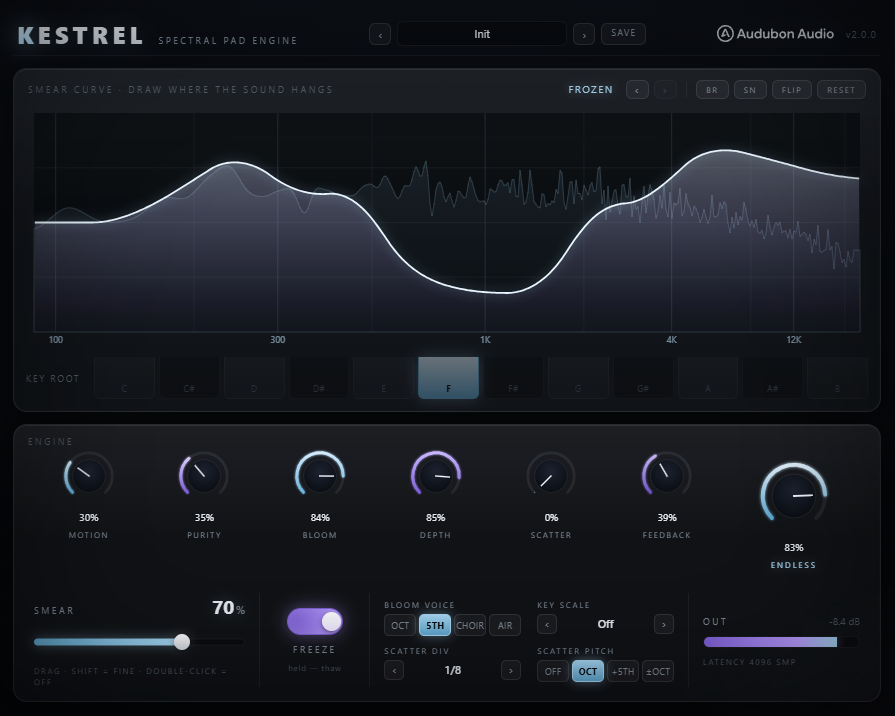
Kestrel.
The bird that hangs in mid-air.
A kestrel wind-hovers — holding one point in the sky, dead still, while the air moves around it. Kestrel holds and blurs the spectrum per band: draw where the sound hangs, then grow real pads out of what you froze. Harmonics added in key, a granular glitch delay, and a one-knob endless reverb.
Freeze is usually all or nothing.
Most spectral freezes hold the whole spectrum at once. You get a static wash, and the parts you wanted to keep moving are stuck along with everything else.
Kestrel makes holding a curve. You draw how much each part of the spectrum hangs, on a hand-calibrated log-frequency axis, so the low end can stay tight while the top blooms — or the reverse.
Four times the resolution, for a reason.
Kestrel is a sibling of Curlew and Loon and shares their curve editor, but it runs a 4096-point FFT with Hann² windowing and 8× overlap — four times their spectral resolution.
That is not a specification for its own sake. Pads need bins narrow enough to keep the individual notes of a chord apart. At lower resolution a held chord smears into a single tone; at this resolution it stays a chord.
From a frozen frame to an actual pad.
Holding the spectrum is the starting point, not the product. Three stages grow it into something playable:
- Harmonics in key. Added against the global key rather than sprayed across the spectrum, so what grows stays consonant with the track.
- Granular glitch delay. Scatter the held material in time.
- Endless reverb. One knob, from a room to a tail that never closes.
The curve editor carries the same BR / SN / FLIP / RESET buttons as Curlew and Loon, with five steps of curve undo.
Documentation.
The full manual lives on the instruction page.