Download Kakapo-v1.0.0-windows-VST3.zip from your Members Area and unzip it. Inside is Kakapo.vst3 — a folder, which is normal for VST3.
Windows: move Kakapo.vst3 into C:\Program Files\Common Files\VST3 — Windows may ask for administrator permission, accept it. macOS: run the .pkg installer instead, which puts the Universal build (Apple Silicon and Intel) in /Library/Audio/Plug-Ins/VST3 for you. Full step-by-step for both: the VST Install Guide.
Rescan plugins in your DAW (in Ableton Live: Options → Preferences → Plug-Ins → Rescan). Kakapo appears under Audubon Audio.
The first time you open Kakapo it asks for your serial — it is in your Members Area, tied to your email. Paste it, activate, done. Without a serial the plugin runs in demo mode: full features, with the audio dipping to silence periodically.
Kakapo goes on an individual bass source — a growl, a reese, an 808, a midrange stab, a DI bass. It tracks one fundamental at a time, so keep it off busses and full mixes. With SUB at zero it is transparent, so inserting it changes nothing until you are ready.
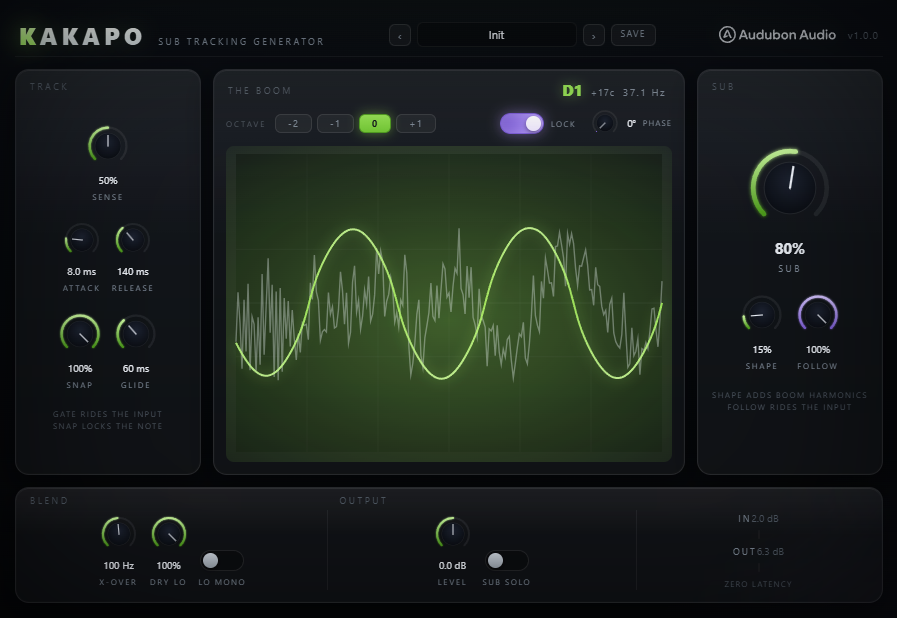
Play the part. The note readout at the top of the center panel locks on — note name, cents, and Hz — and the scope shows the generated sub (the moss trace) over your ghosted dry signal. If the readout says LISTENING, the tracker has not heard a usable pitch yet: check the part is playing and its fundamental is somewhere between 25 and 500 Hz.
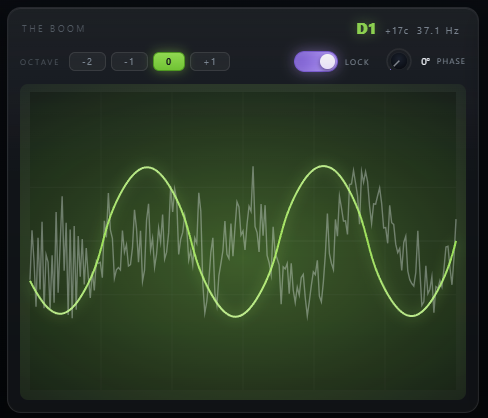
The OCTAVE chips above the scope shift the sub against the tracked note. A bass already living in the sub octave wants 0 — pure reinforcement. A midrange riff wants -1 so its foundation lands an octave below. -2 is the cinematic drone register; +1 is for when you are tracking something very low and want the sub above it.
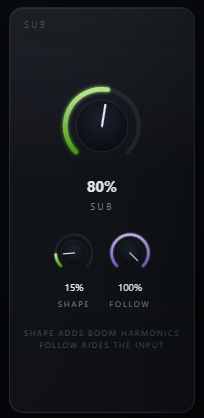
Bring SUB up until the floor sits right against the track — it reaches 150% for when the sub is the star. Then add SHAPE until you can hear the note on small speakers: it morphs the sine toward a rounded square, adding only odd harmonics, so the pitch stays planted while the presence grows. 15–30% is plenty for most material.
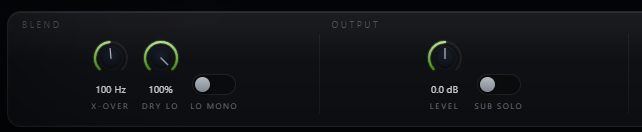
DRY LO is your original low end's fader, working below the X-OVER frequency. At 100% the sub layers under everything you had. Pull it toward 0% and your dry lows disappear — Kakapo's oscillator becomes the entire foundation, which is the move when the original low end is weak, wobbly, or fighting the kick.
If you kept some dry lows, turn LOCK on (it is on by default) and slowly sweep PHASE while listening to the combined low end — or watching the scope. At the right setting the sub and your original lows stack into one bigger wave; at the wrong one they thin each other out. This is the control that makes layering actually work.
How much input it takes to open the sub. Higher is more sensitive. The gate has hysteresis and a minimum-open hold, so a level sitting right at the threshold never stutters the low end. Raise it if quiet notes are being missed; lower it if bleed or noise is triggering subs you did not ask for.
How fast the sub's level rises when a note starts. Short and the sub arrives with the transient; long and it swells in under sustained material.
How the sub lets go when the input stops. Around 100 ms follows a staccato bassline tightly; 400+ ms turns stabs into a sustained floor and rides out half-time gaps.
Chromatic quantize. At 100 the sub always plays the nearest exact semitone — a detuned reese gets a perfectly tuned foundation. At 0 the sub follows the input's exact pitch, bends and all. For 808 slides, use 0 (the Slide Rider preset).
Portamento between notes. Short is tight and steppy; long smears note changes into synth-bass slides. Glide is measured musically, so an octave jump and a semitone step feel equally smooth.
Shifts the generated sub relative to the tracked note. This is a chip row above the scope rather than a knob — pick the register, the tracker does the rest.
A free-running sub at almost-the-same pitch as your dry lows beats against them — the combined low end slowly swells and hollows, which is why naive sine layers sound like mud on long notes. With LOCK on, Kakapo nudges its oscillator to your input's actual cycle, so the relationship between the two stays put. PHASE (0–360°) chooses what that relationship is: sweep it for the fattest sum. When SNAP moves the sub to a different pitch than the input is actually playing, the lock releases automatically — two different notes cannot and should not phase-align.
Phase-locks the sub to the input's fundamental cycle. Leave it on when layering (DRY LO up); it is harmless when replacing, where it simply steadies the scope.
The alignment target for the lock. Tune by ear against your kept lows, or by eye on the scope — the setting that makes the summed low end biggest is the right one.
The generated lane's level. 100% is unity against a full-scale envelope; the headroom above is for replace mode, where the sub carries the whole bottom octave.
Morphs the pure sine toward a rounded square. Odd harmonics only — the third and fifth that make a sub audible on earbuds — never evens, which would read an octave up. High settings are a deliberate character choice; small settings are translation insurance.
How much the sub rides the input's dynamics. At 100 the sub mirrors every accent. At 0 it holds a flat level whenever the gate is open — instant "compressed sub" without touching a compressor. In between blends the two.
Auditions the generated sub alone — for tuning SHAPE, confirming the octave, or bouncing the sub as a separate stem. Click-free in and out.
Where the dry signal splits. Above it, your signal passes completely untouched. Below it is the lane DRY LO controls. The split is phase-matched — with DRY LO at 100 and SUB at 0, Kakapo is flat to a thousandth of a dB.
Your original low end's fader. 100% = layer mode: the sub adds under what you had. 0% = replace mode: your dry lows are removed at the crossover's slope and the generated sub is the foundation.
Folds your kept dry lows to mono below the crossover — wide reese mids, centered bottom octave. The generated sub is already mono by construction, always.
Output trim after everything, for honest level-matched comparisons against bypass. A generator adds energy — match levels before judging.
Load Growl Foundation: OCTAVE −1, X-OVER 150 Hz, DRY LO 30%, SUB 100%. The growl keeps its character above 150 Hz, most of its muddy low end is cleared out, and a tuned sub an octave down carries the weight. Sweep PHASE for the fattest sum with the 30% you kept.
Load Small Speaker Boom: SHAPE at 60% adds strong third and fifth harmonics to the generated sub, so the note reads on a phone while the fundamental stays clean underneath on a system. Blend with FOLLOW around 60 so the sub stays steady through the 808's own decay.
Load Slide Rider: SNAP 0 so the sub follows the slide exactly, GLIDE short so it does not lag. The tracker is built to follow continuous slides without stalling — verified against a 300 ms octave slide in the test suite.
The tracker holds its last pitch through unpitched material. Play one bass note to teach it the key, then feed it kicks: each hit opens the gate and fires the held note as a sub. Long RELEASE (400+ ms), OCTAVE to taste — an instant tuned 808 layer from a plain kick.
The tracker has not accepted a pitch. Check: the part is actually playing into Kakapo; its fundamental is between 25 and 500 Hz; and the level is above roughly −50 dBFS. Raise SENSE if the material is quiet.
The input is hovering around the gate threshold. Move SENSE decisively in either direction — the gate has 6 dB of hysteresis, so a few points is usually enough. Longer RELEASE also bridges short gaps.
That is phase beating between the sub and your dry lows. Turn LOCK on and tune PHASE. If SNAP is at 100 and the source is heavily detuned, the lock releases by design (different pitches cannot align) — either lower SNAP so the sub follows the source's real pitch, or lower DRY LO so there is less dry low end to beat against.
Kakapo is monophonic — on a bus or a chord it picks the strongest fundamental and commits. Move it onto the individual bass source. Drum bleed triggering it? Lower SENSE (less sensitive) so only the bass opens the gate.