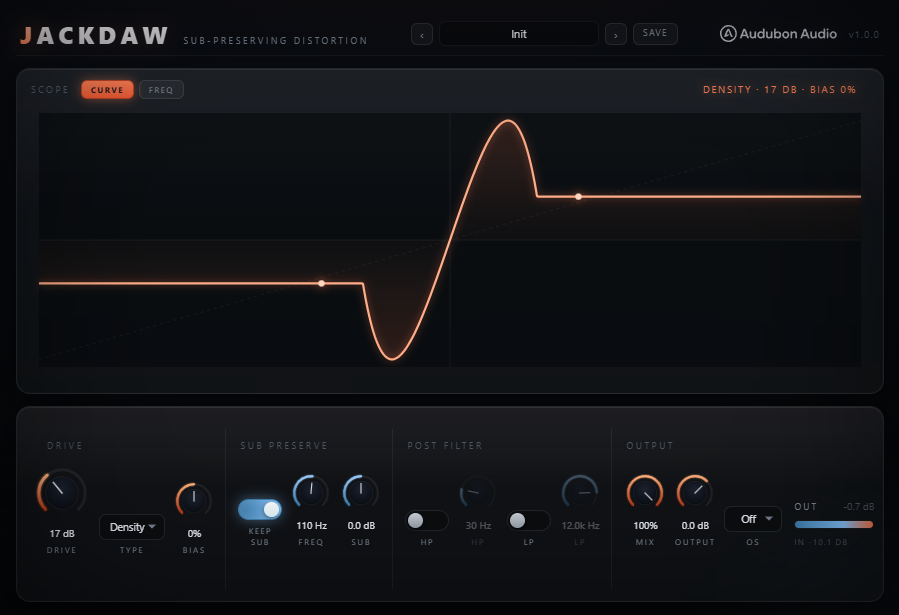
1
Soft
The gentlest curve — rounds peaks without hard edges, a subtle warming saturation.
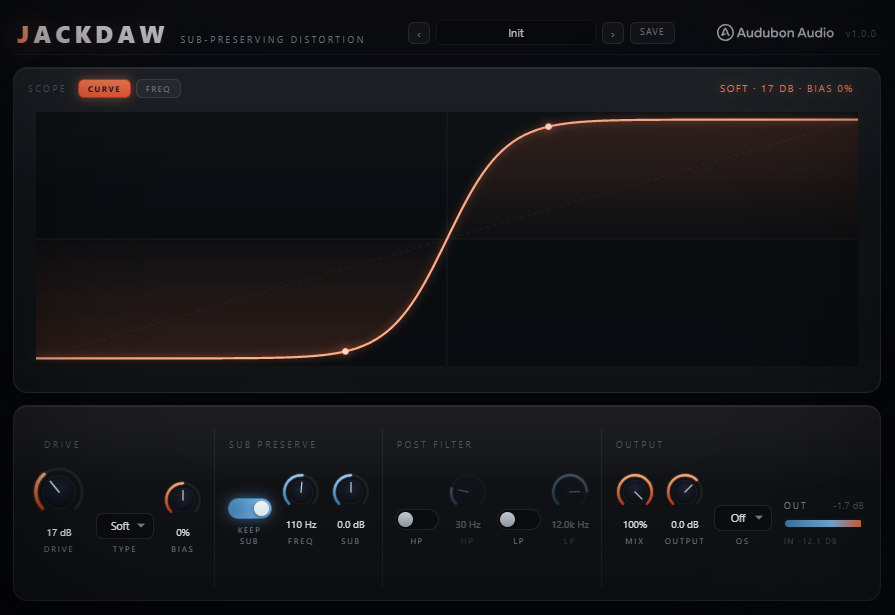
Eight waveshaper curves with zero-latency antialiasing, a reactive drive stage that follows your playing, and two independent, mix-safe ways to protect the low end — every feature a true no-op when you don't need it. Drive it hard up top without losing the weight underneath.
Distortion redistributes energy, and that usually eats the sub weight a bass patch lives on. Jackdaw gives you two independent, mix-safe ways to keep the low end intact — Sub Preserve splits it around the distortion entirely, and Post HP/LP clean up what the distortion generates before it's added back. Both are a true no-op when disabled.
Three scope views tell you exactly what's happening: WAVE shows the live dry-versus-shaped waveform, CURVE shows the live transfer function of whatever shape and bias you've dialed in, and FREQ shows the output spectrum with the protected sub region shaded and the post-filter responses overlaid. And the DELTA chip lets you listen to only what Jackdaw is adding — and hear for yourself that it contains no sub.
With Sub Preserve, Post HP/LP, Dyn, Sag and Tilt all at rest and Bias at zero, Jackdaw skips every one of those stages entirely — the signal path is just Drive into the shaper and out through Mix and Output. Turn on only what the track needs.
Every curve runs through 1st-order antiderivative antialiasing (ADAA) at base sample rate — no oversampling required to keep the top end clean, which is why Oversampling defaults to Off.
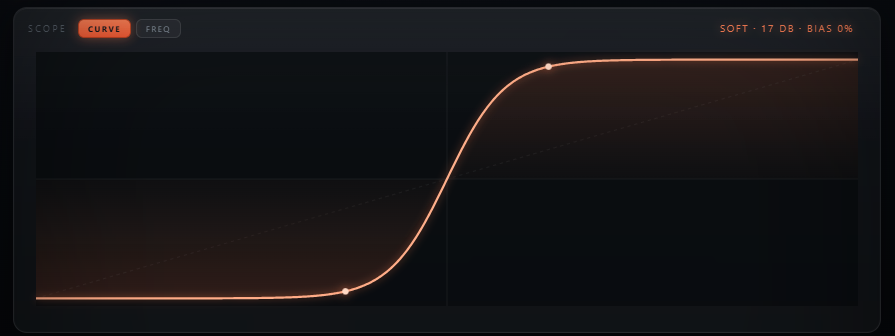
Each curve has a closed-form antiderivative, so aliasing is suppressed mathematically at base rate — no added latency, no need to oversample by default.
Between samples, sub-bass changes so little that ADAA collapses to the exact curve — it only cleans up the high harmonics that actually alias.
Off, 2×, 4×, or 8× on top of ADAA for extreme drive on the hardest curves — a linear-phase FIR with latency honestly reported when engaged.
The CURVE view's JavaScript mirrors the actual DSP shaper code exactly — what you see on screen is what's happening to the audio.
Each Type is a distinct, curated waveshaping curve — pick the character first, then dial Drive and Bias to taste.
The gentlest curve — rounds peaks without hard edges, a subtle warming saturation.
Even-harmonic character reminiscent of driven valve gain stages — warm and musical.
A diode-clipper-style curve with its own distinct onset and knee character.
Wave-folds peaks back on themselves for a denser, more complex harmonic spectrum.
A smooth sinusoidal shaping curve — rounded, musical harmonic generation.
Brickwall clipping — the hardest edge in the set, aggressive odd-harmonic bite.
A denser, thicker curve tuned for adding perceived loudness and body without harshness.
New in v1.1 — a hard six-step staircase with a dense, metallic high-harmonic spray. The digital tearout texture the smooth curves can't make, still alias-suppressed at zero latency.
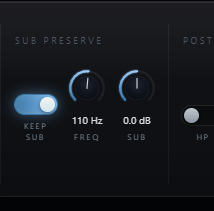
A Linkwitz-Riley crossover splits the input; only the high band is driven and shaped. The untouched sub is added back afterward, pristine.
The dry-for-mix signal is the allpass-reconstructed input, so the sub stays phase-coherent across the entire Mix range — no notching as you blend.
Set the crossover to sit right above your fundamental, and optionally boost the preserved sub back in with Sub Gain.
New in v1.1: one switch folds only the protected sub lane to mono. Club rigs and vinyl are mono down low — a wide sub can cancel on the big system. The top stays as wide as you made it.
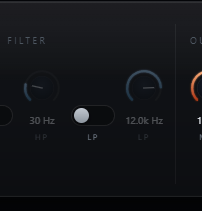
Gentle filters that sit before the sub is re-added — high-pass the distortion's low mud out, or tame fizz up top, without ever touching the preserved sub.
Because Post HP filters the distorted band before the sub returns, you can HP the grit's low mud while the real, untouched sub still comes back underneath.
Bias pushes the curve asymmetric, adding even-harmonic content. A DC blocker (blended by |Bias|) keeps things clean — transparent at Bias 0.
New in v1.1: Tilt tips the spectrum around 700 Hz going INTO the shaper, then applies the exact inverse after it. The tonal balance comes back — what changes is which part of the sound drives the distortion. The classic neuro two-EQ trick, built in and latency-free.
Drive and Bias feed the shaper; Dyn, Sag and Tilt make it react to your playing; Mix and Output finish the blend; Oversampling is there when you need it.
Pre-gain into the shaper — the primary control over how hard the curve is pushed.
Asymmetry into even harmonics. Zero is fully transparent, with the DC blocker skipped entirely.
Envelope-tracked drive. Positive keeps note fronts clean while tails bloom into growl; negative puts the spit on the attacks. Zero is an exact no-op.
Slow bias drift charged by loud sustains, like a pedal's supply sagging — long notes bloom even-harmonic warmth. Short hits never charge it.
±6 dB emphasis around 700 Hz into the shaper, exactly inverted after it — aim the drive at the mids or the lows without changing the balance.
Dry/wet blend. At 0%, the output is bit-transparent bypass.
Final trim for level-matched comparisons against bypass.
Stacks on top of ADAA for extreme drive. Off by default; latency reported honestly when engaged.