⌨
Keyboard
Click any of the 12 pitch classes to light it. Light a single note, a power chord, a full scale — whatever the track needs.
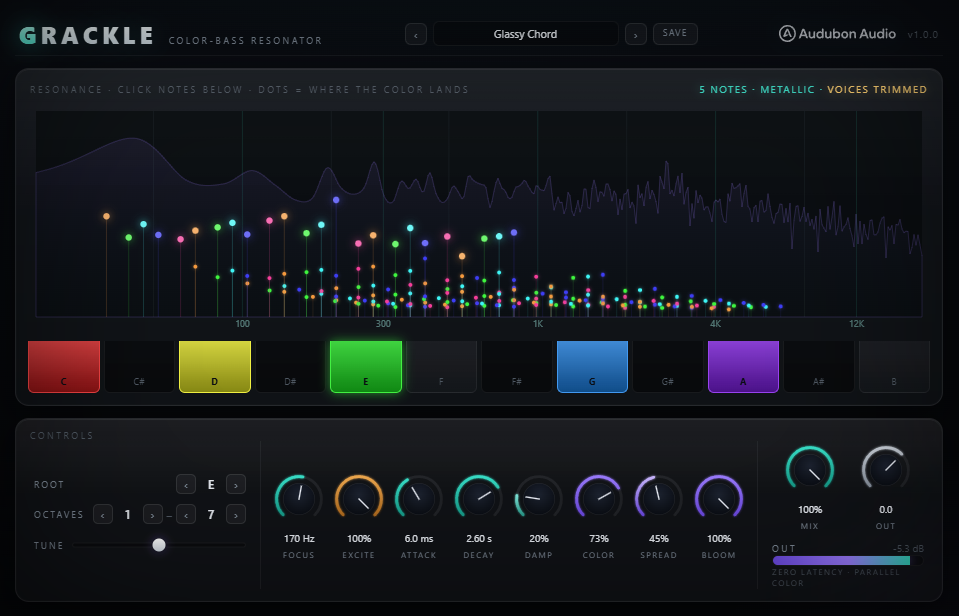
Light up notes on the built-in keyboard and a bank of tuned resonators rings color at those pitches — morphable from glassy and pretty to metallic and bell-like. A Focus crossover keeps everything below it dry, so the sub stays clean and punchy at every setting.
Grackle is a tuned resonator bank locked to whatever notes you light on its built-in 12-key chroma keyboard — a chord, a scale, a single pitch. Whatever hits the plugin with energy near a lit note rings at that pitch, like a resonant EQ that sings instead of just cutting and boosting.
The spectrum display shows resonance landing as colored dots that spread apart as Color rises — you watch the chord's color take shape in real time, not just hear it.
A Focus crossover keeps the resonator bank from touching anything below it — dry stays full-band and untouched in parallel, so the sub never gets tuned, colored, or smeared. At Mix 0% or with no notes lit, the output is bit-identical dry.
One resonator voice per lit note, each tracking its own pitch. Focus is the bass control — it high-passes what excites the resonators and what returns as wet, so nothing tuned ever lands on your fundamental.
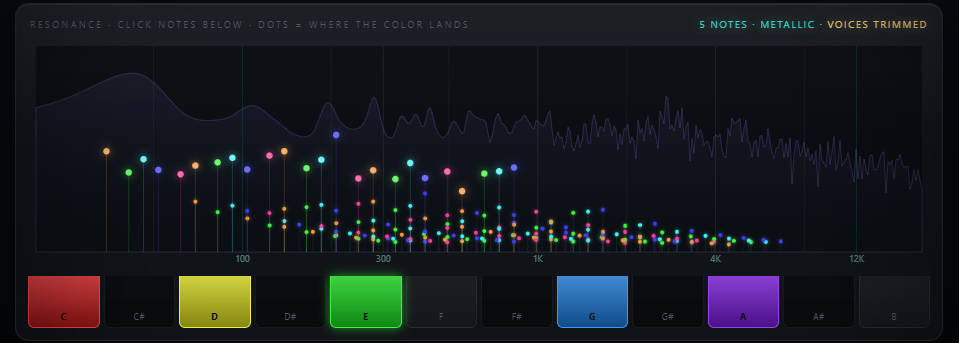
Each lit pitch class gets its own tuned resonator voice, ringing only when the source has energy near it — played-through, not synthesized.
Sets the frequency above which resonance is applied. Everything below stays fully dry — the sub is never resonated, colored, or delayed.
The dry path runs fully in parallel with no added delay, at every Focus, Decay, Color, or Mix setting — safe to use on a live bass bus.
Ring feedback is hard-clamped below unity, so long Decay times never risk runaway self-oscillation, even on dense chords.
Notes are chosen manually on the 12-key chroma keyboard — pitch classes across an octave range, transposed and voiced with a handful of controls.
Click any of the 12 pitch classes to light it. Light a single note, a power chord, a full scale — whatever the track needs.
Transposes the whole lit set to a new key without re-clicking a single note.
Sets how many octaves the lit pitch classes span — a tight cluster or a wide spread across the register.
Fine-tunes the whole set in cents — nudge everything sharp or flat to match a detuned source.
Widens the resonance across the stereo field, tapered off under 120 Hz so low notes stay mono-safe.
Dense chromatic masks trim gracefully, dropping the lowest notes first so the pool never chokes.

At low Color, each voice's overtones stay integer and clean — a smooth, glassy ring that sits naturally under the source.
Push Color up and the partials stretch off the harmonic series into bell and metallic territory — the same axis that defines "color bass" resonators.
The live spectrum display shows resonance as colored dots that visibly spread apart as Color rises — the harmonic-to-metallic morph, made visible.
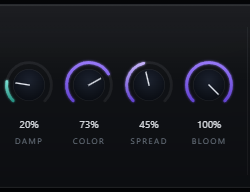
Controls how bright or dark the ring decays — low Damp keeps it shimmering longer at the top, high Damp mellows it into a darker tail.
Adds a lush, spectral shimmer to the wet signal only. Defaults to 0%, which is bit-exact bypassed — no smear and no latency added to the dry until you opt in.
Low Damp and no Bloom gives a tight, bright ring; darken with Damp and add Bloom for a slow, blooming color wash instead.
Focus keeps it bass-safe; Attack and Decay set the envelope; Mix and Output finish the blend.
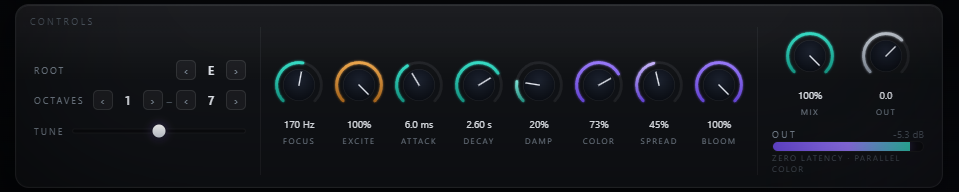
The crossover — resonance only applies above this frequency, keeping the sub dry and clean.
Onset time per voice. Zero for a plucky stab that tracks transients, longer for a slow swell.
Ring length. Short for a percussive color hit, long for a sustained, blooming resonance.
Equal-power dry/wet blend. At 0%, output is bit-identical to the dry input.
Post-mix trim for level-matched comparisons against bypass.