01
Init
All defaults — a gentle Sine fold at 50%. A transparent-leaning starting point to build your own fold from.
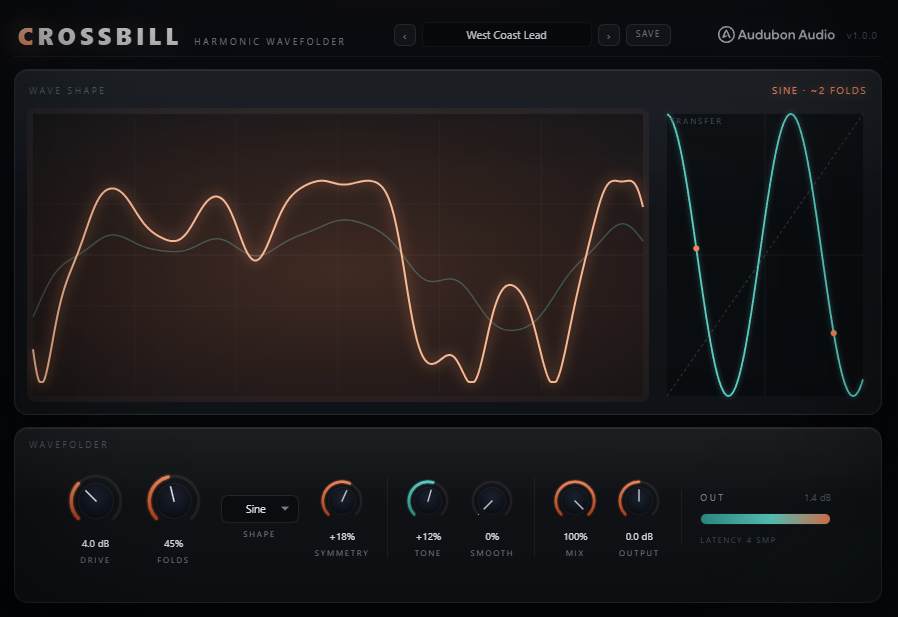
A west-coast harmonic wavefolder for growls and leads. Where a clipper flattens, Crossbill folds the waveform back on itself every time it crosses the threshold — sprouting dense, resonant, metallic overtones. The fold functions are bounded to full scale with unity slope at the origin, so it's transparent when you back off and it can never run away: harder drive adds folds, not level.
A clipper or saturator squashes peaks flat. A wavefolder does the opposite: every time the signal exceeds the fold threshold, it reflects back on itself. Each fold adds a new pair of peaks — and a new burst of harmonics. Push the drive and the wave crosses the fold points more often, so the tone gets denser and brighter without ever getting louder. It's the west-coast (Buchla / Serge) sound: metallic, resonant, alive — perfect for dubstep and DnB growls and screaming leads.
The crossed bill of the bird mirrors the folded wave — harder drive adds folds, not level.
Crossbill runs on Crane-lineage 4× polyphase oversampling to keep fold aliasing in check. A pre-fold Tone tilt decides what hits the folder, Drive and Folds set how hard and how densely it folds, Symmetry biases the fold off-centre to slide between odd and even harmonics, and a post Smooth lowpass tames the fizz. The hero display is a live wave-shape scope — the faint input against the glowing copper folded output — plus a teal transfer-curve inset showing the exact input-to-output map and the current operating point.
Both fold functions — a sine wrap and a reflective period-4 triangle — are bounded to ±1 with unity slope at the origin. That means Crossbill is transparent at low drive (small signals pass through unchanged) and no combination of Drive and Folds can ever push the output past full scale. Instead of getting louder, the sound gets more folded: denser harmonics, brighter timbre, constant ceiling.
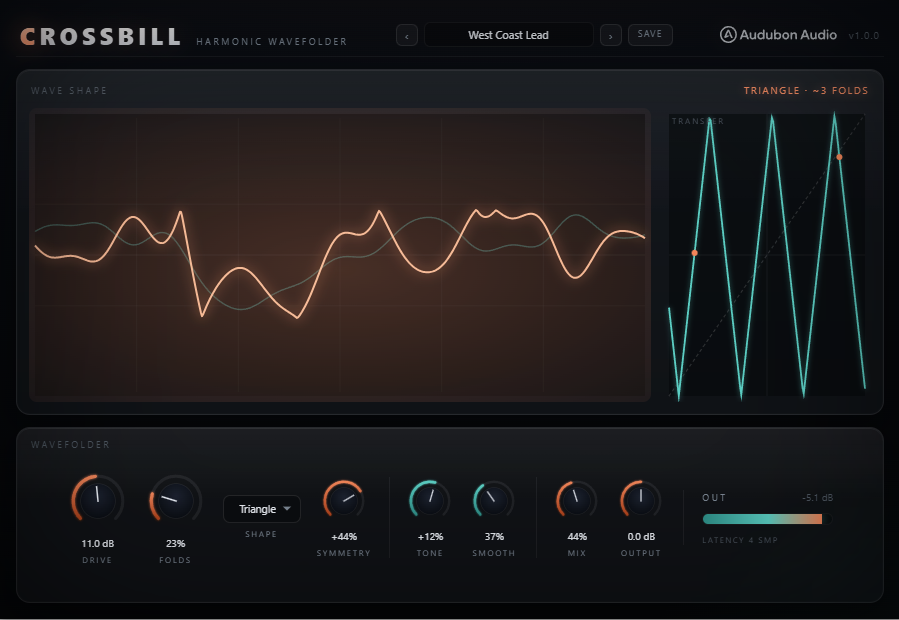
Drive (−12…+36 dB, default +3) is the input gain into the fold stage — it decides how hard you hit the fold points. More drive means the wave crosses the threshold more often, so more folds occur per cycle. Because the folder is bounded, this reads as brightness and density rather than level.
Folds (0–100%, default 50) maps to a 1×–8× fold gain multiplier. At 0% the signal barely folds; at 100% it folds up to eight times per excursion, generating a thick stack of resonant overtones. This is the primary "how metallic" control, independent of Drive.
The fold stage is wrapped in Crane-class 4× polyphase oversampling, with a post-fold Smooth lowpass, to hold aliasing down even at maximum density. The dry path is delay-aligned to the oversampler so the Mix blend stays phase-coherent. Latency is a few samples, host-reported via PDC.
The teal inset plots the actual input→output fold map, computed in the UI from the exact same maths as the C++ DSP. The moving operating point shows where your signal currently sits on the curve — so what you see is always what you hear, with no audio bridge required.
The Shape switch picks the fold function; Symmetry biases the fold point off-centre. Together they set the harmonic character — from round and vocal to sharp and metallic, and from pure-odd to a full odd-plus-even spectrum.
The Sine fold wraps the signal through a smooth sinusoid. Folds are rounded, so the harmonics roll off more gently — the classic Buchla-style timbre. Warmer and more musical for leads, pads and softer growls.
The Triangle fold uses a reflective period-4 triangle. The corners are sharper, so the harmonics extend further and buzz harder — the aggressive, metallic reese/growl side. Pair with a touch of Smooth to keep the top under control.
Symmetry (−100…+100%, default 0) applies a pre-fold DC bias so the wave folds off-centre. Centred folding is purely odd-harmonic; biasing it introduces even harmonics for a hollower, more vocal, or brassier tone. A DC blocker after the fold keeps the output centred.
Three controls shape the sound around the fold core: Tone decides what frequencies hit the folder, Smooth tames what comes out, and Mix parallels the folded signal against the delay-aligned dry.
Tone (−100…+100%, default 0) is a ±6 dB tilt about 700 Hz applied before the folder. Tilt bright to send more highs into the fold for a fizzier, more aggressive result; tilt dark to fold mostly low-end for a thicker, rounder growl. Because it's pre-fold, Tone changes which harmonics get generated, not just the output EQ.
Smooth (0–100%, default 0) is a lowpass after the fold, sweeping 20 kHz down to 1.5 kHz. Use it to tame the fizz and harshness that dense folding creates — dial in just enough to sit the growl in a mix without dulling it.
Mix (0–100%, default 100) blends the wet fold against the dry — the dry copy is delay-aligned to the oversampler latency, so parallel folding stays phase-coherent. Output (±24 dB) is the final trim to match levels against bypass.
Eight controls, no menus. Ranges and defaults below trace directly to the plugin's parameter layout.
Input gain into the folder — how hard you hit the fold points. More drive = more folds per cycle = denser, brighter overtones. Bounded, so it never overshoots full scale.
Fold density, mapping to a 1×–8× fold gain. The primary "how metallic" control — raise it for a thicker stack of resonant harmonics.
Pre-fold DC bias. Centred = pure odd harmonics; off-centre slides in even harmonics for a hollow or brassy character. DC-blocked after the fold.
The fold function. Sine = rounder, west-coast; Triangle = sharper, metallic with more extended harmonics.
Pre-fold tilt (±6 dB about 700 Hz). Decides which frequencies hit the folder — bright for fizz, dark for a thicker growl.
Post-fold lowpass (20 kHz → 1.5 kHz) to tame fold fizz and harshness. Blends the growl into a mix without dulling the body.
Dry / wet blend. The dry path is delay-aligned to the oversampler, so any parallel setting stays phase-coherent.
Final output trim after the blend, with a live Out meter. Match levels against bypass.
Each factory preset resets every parameter to default and then applies its overrides, so it's a clean, reproducible starting point. Save your own as .crossbillpreset files.
All defaults — a gentle Sine fold at 50%. A transparent-leaning starting point to build your own fold from.
Moderate Sine folding with a touch of Symmetry and bright Tone. The classic Buchla-style singing lead.
Dense Triangle folds with bright Tone and a little Smooth. Sharp, metallic reese territory.
Heavy Triangle folding, negative Symmetry for even-harmonic bite, Smooth to tame it, slightly parallel. Aggressive dubstep growl.
Light Sine folds, no drive, heavily parallel. Adds gentle overtone weight to a sub without changing its level.
Bright, dense Triangle folds blended low against the dry. A crushed-air fizz layer over a clean foundation.
Sine folds with strong positive Symmetry and warm Tone. A hollow, brassy, bell-like resonance for melodic parts.