01
Init
All defaults, Sub in Clean mode. A clean pass-through with every module primed — build your own phat chain from here.
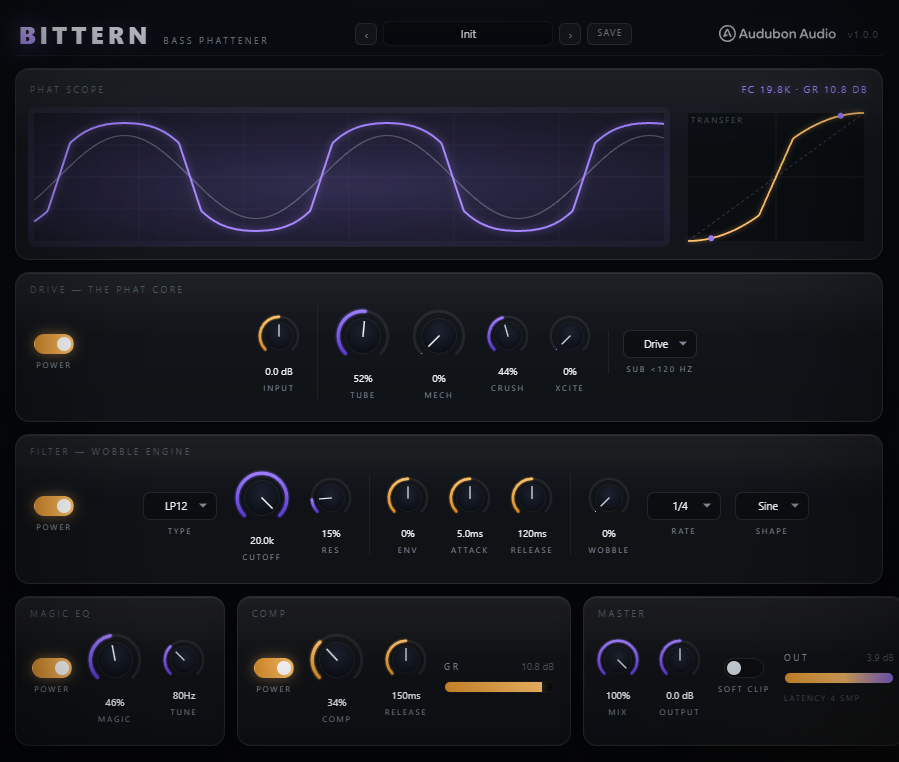
Bittern is a bass-colouring multi-effect built for heavy dubstep — vintage-voiced Tube and Mech distortion running into a filter with an envelope follower, a Magic EQ, and a glue compressor. It models that classic drive character in closed form, adds one dialled-in LFO wobble engine, and wraps the whole chain in a sub-safety layer most distortion boxes never had.
The American Bittern — the "thunder-pumper" — is a marsh bird famous for its booming, sub-frequency call. Fitting, because Bittern is a dedicated bass-phattening chain: drive it, wobble it with a filter, thicken it with a Magic EQ, and glue it with a compressor. Every stage is voiced after the classic bass multi-effects, then wrapped in the Audubon family's sub-safety religion so it can crush and colour heavy bass without ever wrecking the low end.
Vintage-voiced Tube and Mech curves — solved in closed form — with a bass-safety layer most distortion boxes never had.
The two distortion shapers — a warm valve Tube and a hard-knee Mech grit — are defined as exact closed-form curves, continuous to full scale. On top of that sit a bit-crusher, an Aphex-style HF exciter, a TPT state-variable filter driven by an envelope follower and a tempo-synced LFO, a three-band Magic EQ, and a one-knob compressor. A Sub Guard splits the low end off with an LR4 crossover so full-band drive never destroys your sub — and an optional soft-clip ceiling, off by default per the family rule.
The heart of Bittern is the drive stack — Mech and Tube in series, both defined as exact closed-form curves and continuous to full scale. A bit-crusher and an exciter round out the colour. The whole stack runs inside 4× oversampling.
A piecewise-linear hard-knee clipper: linear below the knee, a shallower slope above it. Continuous at the knee but slope-discontinuous — that kink is the "digital grit" that gives Mech its character. Full-scale in maps to full-scale out at every knob position.
A linear core with a per-side parabola whose vertex sits exactly at full scale — the warm, biting valve character. Knob 0 is click-free identity; from knob 1 up it matches the original table row-for-row. A Tube-tracked low shelf (+4.5 dB @ 180 Hz at full) adds the low-end fullness for weight.
A bit-depth crusher sweeping from 16 bits down to roughly 2.5 effective bits at 100%. Dubstep grit and digital nastiness on demand — 0% is fully off (clean bypass), so it only bites when you ask.
An Aphex-style biased-tanh exciter on content above 1.2 kHz, generating even + odd harmonics for presence and air. The generated content is high-passed at 400 Hz so it adds sheen up top without muddying the sub — bass-safe by construction.
Classic full-band distortion drives everything — great on a synth, ruinous on a sub-heavy dubstep bass. Bittern adds a Sub Guard: an LR4 crossover at 120 Hz that decides what happens to the low end while the rest of the signal goes through the full drive chain. It's the family's bass-safety religion, applied to a distortion box.
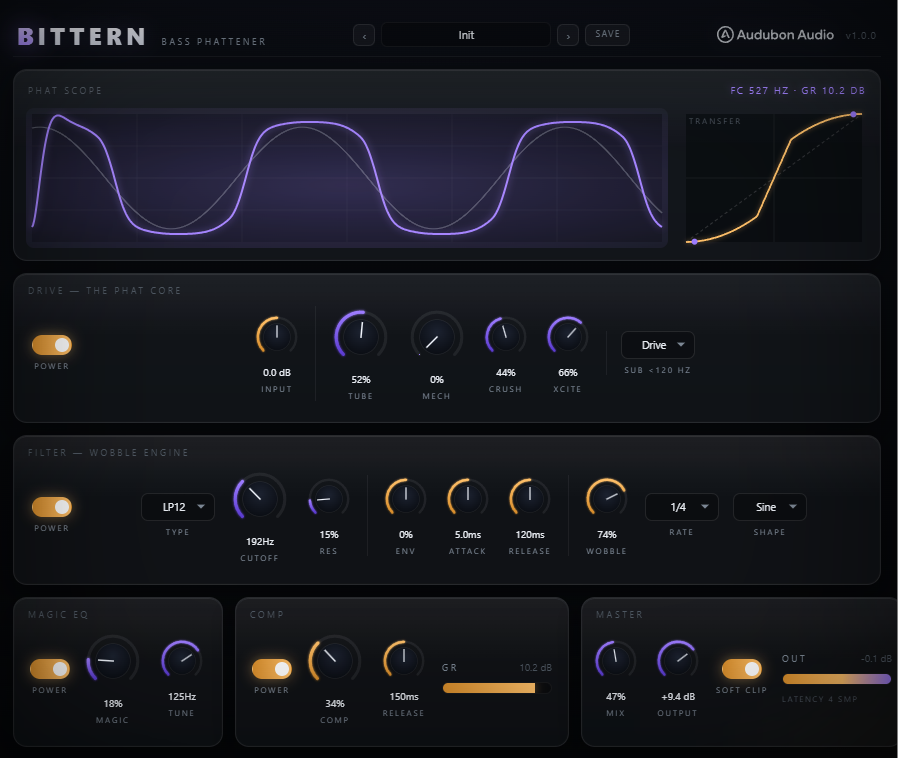
The whole signal — sub included — goes through the drive path. The classic full-band behaviour, for when you want the low end saturated too. Use it on synths and mid-heavy bass where a driven sub is part of the sound.
The default. Everything above 120 Hz is driven and coloured; everything below bypasses the drive chain untouched and is delay-aligned back in. Your sub stays exactly as it came in while the harmonics get mangled on top.
A middle ground: the highs go through the full chain, but the sub receives only the Tube shaper for gentle harmonic weight — no clipping, crush or filtering. Adds valve thickness to the low end without the destructive full-band drive.
After the drive stack, the signal hits a TPT state-variable filter — and the filter's cutoff is alive. It can track the input dynamics via an envelope follower and sweep in time with your track via a tempo-synced LFO, both at once. This is the wobble engine, and it's where dubstep bass comes alive.
Four types — LP12, LP24, BP, HP — with Cutoff (20 Hz–20 kHz, log) and Res (Q 0.5–8). Coefficients update per sample and the cutoff is smoothed in the log domain, so even slammed modulation stays stable and click-free.
An abs-peak detector with Attack (0.1–100 ms) and Release (10–1000 ms) drives the cutoff up to ±4 octaves via the bipolar Env amount. Positive opens the filter on transients for auto-wah snap; negative ducks it. The amber knobs carry this motion.
One LFO — Wobble depth (up to 3 octaves) with six shapes (Sine, Tri, Saw Up/Dn, Square, Rand) and 12 tempo divisions from 4 bars down to 1/32 including dotted and triplet. Beat-locked to host transport when playing, free-running at last BPM when stopped.
Two one-knob finishers voice and control the result, then the master section blends and caps it. Magic EQ is a single macro that voices three bands at once; Comp is a one-knob glue compressor; Master handles Mix, Output and an optional ceiling.
One Magic knob voices three bands together: a low shelf at Tune (up to +7.5 dB), a mud-scoop dip at 5× Tune (up to −3 dB), and a presence lift at 2.8 kHz (up to +4 dB). Tune (40–160 Hz) sets where the weight lands. Instant "phat" without touching a full EQ.
A one-knob 4:1 soft-knee compressor with threshold-tracking auto-makeup — Comp sets the amount, Comp Rel (30–800 ms) the release. Tuned so it lands loud and full like the original, with a cut-only gain-reduction meter. Glue for the whole bass.
Mix (0–100%) blends the whole wet chain against the delay-aligned dry for parallel phattening. Output trims ±24 dB. Soft Clip is an optional tanh ceiling — off by default, per the family rule that true-peak/clip modes never default on.
Twenty-six parameters across five sections. Violet knobs shape tone; amber knobs carry motion and dynamics. Each module has a power toggle that hard-bypasses it with state kept primed, so toggling is click-free.
Input trim before the drive stack. Use it to push harder into the Mech and Tube curves or to match gain into the plugin.
The warm-bite valve shaper (exact closed-form curve) with a tracked low shelf for fullness. Click-free identity at 0.
The hard-knee grit shaper (exact closed-form curve). Series after Tube. The slope-kink is the digital-grit character.
Bit-depth reducer, 16 → ~2.5 bits. 0% = off. Digital grit and aliasing for dubstep nastiness.
Aphex-style HF exciter above 1.2 kHz, generated content HP'd at 400 Hz. Presence and air, bass-safe.
Sub Guard mode (LR4 @ 120 Hz). Drive = full-band; Clean = sub bypasses; Warm = sub gets Tube only.
TPT state-variable filter response. LP24 for steep dubstep sweeps, BP for the "talking" env sound.
Base cutoff (log, def 20 k = open) and resonance (def 15%). The point the env and LFO modulate around.
Bipolar envelope-to-cutoff amount, up to ±4 octaves. Positive = auto-wah open on transients; negative = duck.
Envelope follower timing (def 5 ms / 120 ms). Fast attack for snap; slower release for smoother movement.
LFO depth (def 0) and tempo division (def 1/4, 12 options incl. dotted/triplet). Beat-locked to host transport.
LFO waveform (def Sine). Square and Rand land click-free thanks to the log-domain cutoff smoother.
Magic (def 0) voices low shelf + mud dip + presence together; Tune (def 80 Hz) sets where the low weight lands.
One-knob 4:1 glue with threshold-tracking makeup (def 0), release def 150 ms. Cut-only GR meter.
Dry/wet against the delay-aligned dry (def 100%) and final trim (def 0). Parallel phattening lives here.
Optional tanh output ceiling. Off by default — the family never defaults a clip/true-peak mode on.
Each factory preset resets every parameter to default and then applies its overrides, so it's a clean, reproducible starting point. Save your own as .bitternpreset files.
All defaults, Sub in Clean mode. A clean pass-through with every module primed — build your own phat chain from here.
Moderate Tube, a little Xcite, Magic EQ and light comp. The everyday thicken-and-glue starting patch.
Heavy Tube with a touch of Mech, strong Magic and comp. Big, booming, pumped — the thunder-pumper itself.
Tube drive into a resonant filter with a 1/4-note LFO wobble. The bread-and-butter dubstep sweep.
Mech and Crush into a resonant filter with a dotted-1/8 LFO. Syncopated, gritty growl movement.
Mech into a band-pass filter with a fast, deep envelope follower. The "talking", vowel-like neuro sound.
Heavy Crush and Mech with Xcite and comp. Aggressive, lo-fi, digital destruction for rude drops.
Sub Guard in Warm mode with Tube and strong Magic. Adds valve weight to the low end while keeping it solid.
Light Tube, heavy Xcite, and a hard, slow-release compressor. Squashed, glossy, present — great for reeses.
Tube 50 / Mech 50, full-band Sub Drive, soft-clip on. The classic full-band distortion sound, faithfully.