1
Boost
A transparent clean-blend boost stage modeled on the mythical gold boost pedal — it lifts and firms without smearing the transient. At 0 it is a hard bypass.
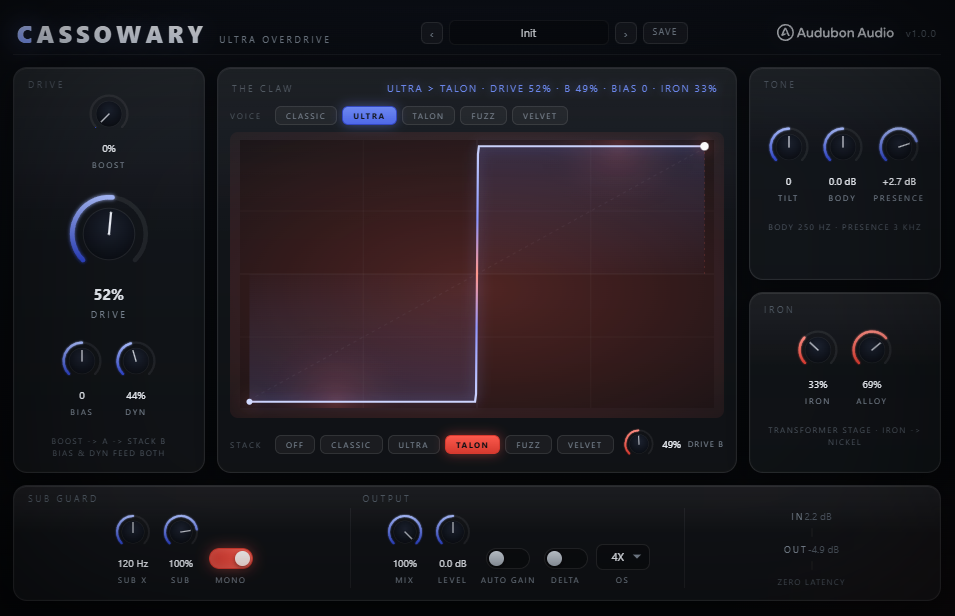
The world's most dangerous bird gets the world's most dangerous overdrive. Five circuit-modeled drive voices — two generations of the legendary green screamer circuit, a hard-clip rodent-style stage, a two-stage cascade fuzz and a warm low-gain valve stage — plus a STACK slot that runs any voice into any voice, behind a transparent clean-blend boost and in front of a transformer output stage. All of it wrapped in an LR4 Sub Guard, so the claw only ever comes down on the top end.
Cassowary is not a curve you draw or a shape you pick from a list — it is a modeled analog chain, in order: a transparent boost, a drive stage with five circuit voices, a stackable second drive stage, a three-band tone section, and a transformer output stage. A Linkwitz-Riley Sub Guard splits the sub out before any of it and folds it back in clean, so a bass patch keeps its weight no matter how hard the top is pushed.
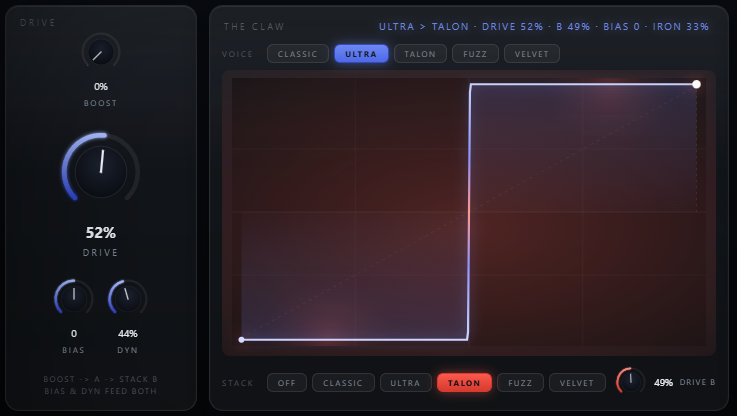
The centre of the interface is THE CLAW — a live transfer-curve display. The curve you see is the drive law you have dialed in, with the input and output level riding it as a ball, and a heat glow that blooms with the drive amount as signal passes through. Nothing on screen is decoration: it is the shape the audio is actually being pushed through.
Every colour stage is honest about doing nothing. BOOST at 0 and IRON at 0 are hard bypasses, not near-unity settings. TILT at centre is an exact identity. DYN at 0 is a factor of exactly one. MIX is a phase-aligned dry blend with no latency to compensate. Turn on only the parts the track needs.
The clipper at the heart of Cassowary is a wave digital filter — the diode network is solved per sample, with its real feedback capacitance, so the knee, the recovery and the level dependence behave the way the circuit does rather than the way a static curve does.
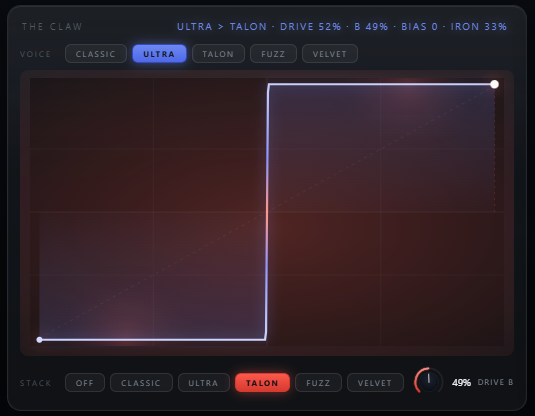
The clipping stage is a wave-digital model of a real diode feedback network, evaluated sample by sample. Bounded no matter what you feed it, and asymmetric the way a biased circuit is — not the way a lookup table is.
The whole chain — boost, drive, tone, transformer, Sub Guard and dry blend — reports zero latency to the host. The dry path for MIX is time-aligned, so blending never combs.
Off, 4× standard or 8× HQ, applied to the boost, drive and transformer cores, with no reported latency at any setting. 4× is the default; go to 8× when you are pushing extreme drive into bright material.
The hero display draws the live transfer curve with the signal riding it, and glows hotter as drive rises. You can see the asymmetry BIAS adds and the way DYN moves the curve with your playing.
Signal above the Sub Guard crossover runs boost into drive into stack into tone into iron — the same order you would build it on the floor, with the colour stages hard-bypassed until you turn them up.
A transparent clean-blend boost stage modeled on the mythical gold boost pedal — it lifts and firms without smearing the transient. At 0 it is a hard bypass.
The overdrive itself: CLASSIC, ULTRA, TALON, FUZZ or VELVET — five circuit voices, with BIAS for asymmetry and DYN for envelope-tracked gain.
A full second drive stage: any of the five voices with its own DRIVE B, run after stage A — two pedals in series, in one box. OFF is a hard bypass.
TILT tips the balance dark-to-bright around the clipped signal, BODY is a 250 Hz shelf and PRESENCE a 3 kHz shelf. All three rest at centre, doing nothing.
A hysteresis-modeled transformer output stage. ALLOY morphs the core from clean iron to coloured nickel; IRON at 0 is a hard bypass.
Every voice is a modeled circuit with its own gain structure and its own knee — and the STACK row underneath THE CLAW runs a second one after the first, the way players have chained drive pedals forever. Five voices, five stack partners, one BOOST in front and one transformer behind: that is 25 stacked drive laws before you touch a tone control.
A living model: bias drifts under sustained level the way a blocking-distortion stage does, the harmonic content changes with how loud you hit it, and the mids and highs are driven separately. Its mid hump sits at 980 Hz, +7.2 dB.
The default. A 30 Hz coupling high-pass into a 720 Hz Q1.5 mid hump at +6 dB, a hard ×41 drive, and three cascaded wave-digital diode clipper stages. The tearout voice.
A rodent-style hard clipper: a rising-treble gain stage into a silicon pair on a tight 1 kΩ source, so the knee lands late and bites hard — clean right up until it suddenly is not — with a fixed post filter to keep the fizz civilised. The neuro mid-grind voice.
Two cascaded gain-into-clip stages, big-box style: the second stage re-clips the first stage's already-flattened output into a proper wall. No baked-in mid scoop — on a bass bus it still cuts; if you want the scoop, TILT is right there.
A low-gain valve-style stage biased warm on purpose: second-harmonic colour is there even at zero drive, and the gain ceiling is modest, so it thickens instead of tearing. Beautiful alone on a Reese bed — and the natural stack partner for rounding off anything placed before it.
The STACK row loads any voice as a second stage with its own DRIVE B — stage A runs into stage B in series, exactly like chaining pedals. Push a screamer into the hard clip to tighten it, or land anything on VELVET to round it off. OFF is a true hard bypass.
BIAS offsets the signal into every clipper — centred it is symmetric and odd-harmonic, moved it brings even harmonics up. DYN is an envelope follower (1 ms attack, 30 ms release) that scales drive with your playing. Both feed stage A and the stack alike; at rest both are exact no-ops.

A 4th-order Linkwitz-Riley crossover splits the input before the pedals. Only the high band sees boost, drive, tone and iron; the low band is carried around all of it and summed back untouched.
Set the split right above your fundamental — 120 Hz by default — so the harmonics get mangled and the weight underneath does not.
The clean sub returns at unity by default, and can be pushed a little past it when a heavily driven top needs more anchor underneath.
Folds only the protected low lane to mono — the dubstep default, on out of the box. Club rigs are mono down low; the top of the sound keeps every bit of the width you gave it.
Boost, drive and iron set the colour; tilt, body and presence shape it; the Sub Guard protects the bottom; mix, level and the utility switches finish the job.
The clean-blend boost stage. At 0 it is hard-bypassed, so the stage cannot colour anything until you ask it to.
How hard stage A's voice is pushed. The one knob that decides whether this is warmth or damage.
The stack stage's own drive. Lives in the STACK row, and dims until a stack voice is loaded.
Pre-clipper offset. Centre is symmetric and odd-harmonic; away from centre brings in even harmonics.
Envelope-tracked drive from a 1 ms / 30 ms peak follower. Exactly no-op at 0.
Tips the clipped signal dark or bright. Centre passes the clipped signal through exactly.
Low shelf on the driven band — put the chest back in after the clipper thins it, or take out the honk.
High shelf on the driven band, for the bite that cuts through a busy mid range.
Drive into the transformer output stage. Hard-bypassed at 0.
Morphs the transformer core from clean iron toward coloured nickel — more even harmonics, more high-frequency saturation.
The Sub Guard crossover point. Everything below it bypasses the whole pedal chain.
How much of the clean, protected low band comes back into the sum.
Phase-aligned dry blend with no latency to compensate. At 0 the output is the dry signal.
Output trim, for level-matched comparisons against bypass.
Picks stage A's circuit: dynamic screamer, three-stage screamer, hard clip, cascade fuzz or warm valve stage.
Loads a second drive stage after stage A — same five circuits, its own Drive B. Off is a true hard bypass.
Oversampling for the boost, drive and transformer cores. Higher settings buy cleaner top end at extreme drive.
Folds only the protected low lane to mono. On by default, because bass music wants it that way.
RMS level matching across the drive range, clamped to ±18 dB. Off by default so nothing touches your level unasked.
Monitors wet minus dry — exactly what Cassowary is adding, and proof that the sub is not in it.